 ChipApex | Global Electronic Components Supplier

SEARCH
Search Product
Search Post
— IC芯片 | 连接器 | 传感器 | 被动器件 —
Search productSearch post
— IC芯片 | 连接器 | 传感器 | 被动器件 —
Consult the customer manager about the wholesale price.
consultation hotline:86-132-6715-2157
email:[email protected]
Contact the product manager for consultation. One-stop consultation is available.
Do you want a lower wholesale price? Please send us your inquiry and we will reply immediately.
The Hoffman CBP105 is a cable entry plate designed for use with Hoffman enclosure systems. Constructed from steel, this component features a rectangular shape with multiple pre-drilled holes to facilitate the organized passage of cables and wires into an enclosure. It serves as a mounting interface that allows for secure cable management while maintaining the structural integrity of the enclosure panel. The plate is engineered to fit specific Hoffman enclosure models, providing a standardized solution for cable routing needs in industrial control applications.
Verify compatibility with the specific Hoffman enclosure model before procurement. Confirm material specifications and finish requirements match project standards. Ensure the part number corresponds exactly to the required dimensions and hole pattern. Check for any associated hardware or accessories needed for installation. Review technical drawings for precise mounting details.
Select based on enclosure model compatibility and required cable entry density. Consider the material construction for environmental resistance if applicable. Evaluate the hole pattern against the specific cabling requirements of the application. Ensure the plate dimensions align with the available space within the enclosure structure.
This component belongs to the Hoffman Enclosures product line, which specializes in protective housing solutions for electronic and electrical equipment. Cable entry plates like the CBP105 are essential accessories that enhance the functionality of standard enclosures by providing dedicated pathways for wiring. They help maintain cleanliness and order within the enclosure, reducing the risk of damage to cables and improving overall system reliability.
 CBP105

A perfect storm of surging demand and supply chain disruptions is roiling the global electronic components market, with advanced semiconductors and critical materials now…
Read More
Choose a vibration sensor for machine monitoring. Compare sensing methods, bandwidth, noise and mounting, then define the signal-chain requirements.
Read More
Find out when a bare shock switch needs a pull resistor, when an MCU internal pull-up is enough, and why sensor modules and piezo…
Read More
Wilmington, Mass. & Milpitas, Calif. – May 19, 2026 – Analog Devices, Inc. (NASDAQ: ADI), a global leader in high-performance analog and mixed-signal semiconductors,…
Read More
The global electronics industry is facing an escalating shortage of tantalum capacitors, a critical passive component, as surging demand from AI servers, automotive electronics,…
Read More
Select a bridge rectifier by reverse voltage, capacitor charging current, startup surge and cooling. Work through a stated DC voltage and ripple example.
Read More
Understand automotive relay terminals, coil suppression and load ratings. Check inrush, socket compatibility and temperature before selecting a replacement.
Read More
Recently, a survey by the Electronic Components Industry Association (ECIA) revealed that the sales sentiment of global electronic components remained optimistic in the third…
Read More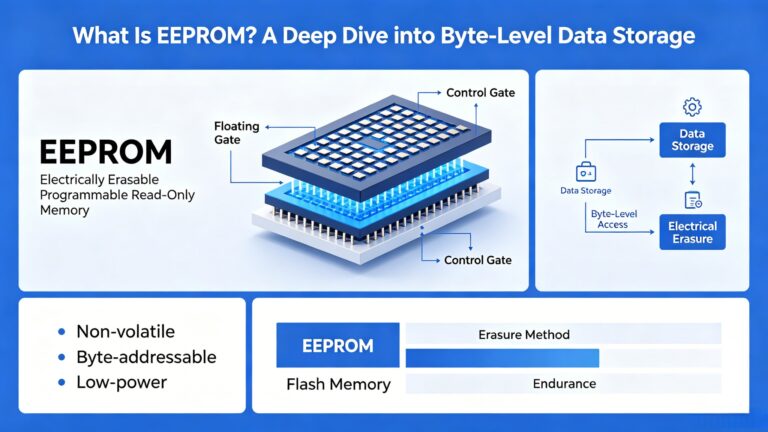
In the vast landscape of memory technology, EEPROM (Electrically Erasable Programmable Read-Only Memory) often plays the unsung hero. While NAND Flash grabs headlines for…
Read More
Choose a DIP switch by contact type, coded positions, footprint and signal ratings. Check logic polarity, assembly conditions and PCB configuration behavior.
Read More
See when an inductor behaves linearly, how DC bias and saturation reduce inductance, and which current and temperature curves to check.
Read More
Learn how a diode conducts, how to identify anode and cathode, and when to choose rectifier, TVS, Zener or photodiode types for a circuit.
Read More
The activity of extra discounts on wholesale prices is in full swing…
Please fill in your contact information and we will send you the latest wholesale price list.




