 ChipApex | Global Electronic Components Supplier

SEARCH
Search Product
Search Post
— IC芯片 | 连接器 | 传感器 | 被动器件 —
Search productSearch post
— IC芯片 | 连接器 | 传感器 | 被动器件 —
Consult the customer manager about the wholesale price.
consultation hotline:86-132-6715-2157
email:[email protected]
Contact the product manager for consultation. One-stop consultation is available.
Do you want a lower wholesale price? Please send us your inquiry and we will reply immediately.
CD4007UBEE4 is listed in the Specialty Logic range at ChipApex. The manufacturer field lists Texas Instruments. Its product description is CMOS DUAL COMPLEMENTARY PAIR PLU. Review the specifications below when checking this part for your BOM.
The CD4007UBEE4 is a CMOS integrated circuit containing dual complementary pairs and an inverter. It features two N-channel enhancement-mode MOSFETs, two P-channel enhancement-mode MOSFETs, and one inverter within a single package. The device operates with a supply voltage range of 3 V to 18 V and supports a wide operating temperature range from -55 °C to +125 °C. It is housed in a 14-lead plastic dual-in-line (PDIP) package.
Verify the specific ordering suffix against the manufacturer's Package Option Addendum to confirm the exact physical package type and material composition. Ensure that the selected variant meets the required moisture sensitivity level and lead finish specifications for the intended assembly process. Cross-reference the active production status with current distributor availability to confirm immediate shipment capability.
Select this component when a design requires both complementary MOSFET pairs and an inverter in a single footprint. Consider the PDIP-14 package constraints regarding thermal dissipation and board space. Evaluate the 3 V to 18 V supply range compatibility with the system power rails. Confirm that the static current requirements align with the low-power characteristics typical of CMOS technology.
This part belongs to the CD4000B series of CMOS logic devices manufactured by Texas Instruments. The series is known for high noise immunity and broad supply voltage flexibility. The CD4007UB specifically provides analog switching capabilities alongside digital logic functions, distinguishing it from standard logic gates.
CD4007UBE
The device contains two N-channel enhancement-mode MOSFETs, two P-channel enhancement-mode MOSFETs, and one inverter.
The maximum recommended supply voltage is 18 V.
Explore related parts through Logic, Integrated Circuits (ICs), all product categories, ChipApex homepage.
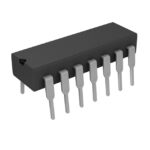 CD4007UBEE4
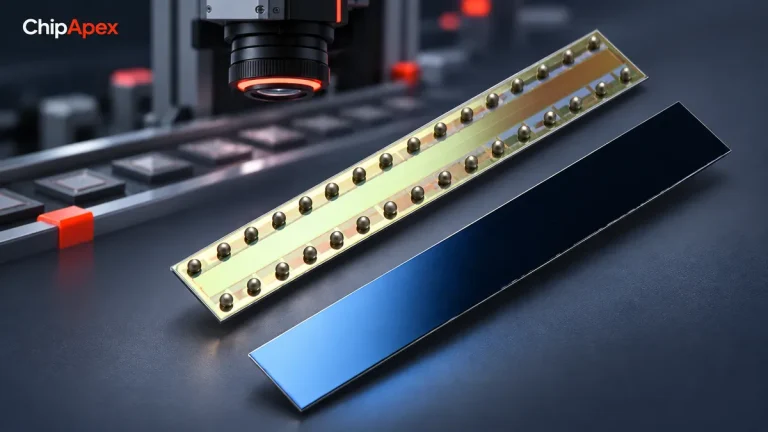
Learn how optical sensing works, compare detection methods, and select sensors by target surface, ambient light, response time and electrical interface.
Read More
CD4007UBEE4 is listed in the Specialty Logic range at ChipApex. The manufacturer field lists Texas Instruments. Its product description is CMOS DUAL COMPLEMENTARY PAIR…
Read More
CD4007UBEE4 is listed in the Specialty Logic range at ChipApex. The manufacturer field lists Texas Instruments. Its product description is CMOS DUAL COMPLEMENTARY PAIR…
Read More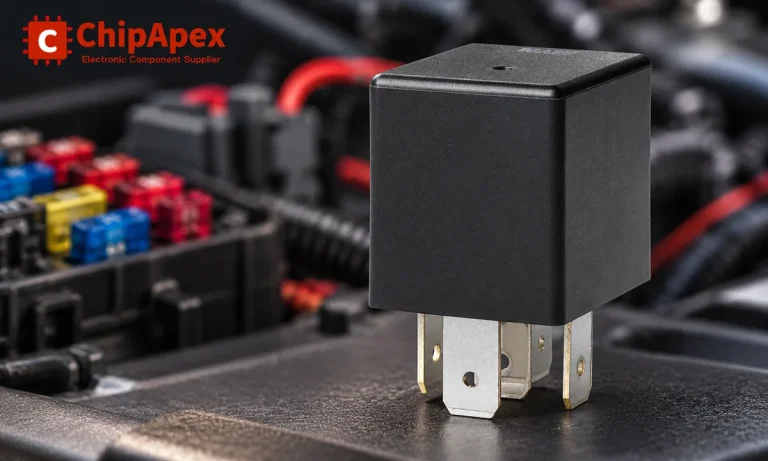
Learn the relay definition, coil and contact operation, NO and NC forms, load ratings and suppression choices. Compare mechanical, reed and solid-state types.
Read More
CD4007UBEE4 is listed in the Specialty Logic range at ChipApex. The manufacturer field lists Texas Instruments. Its product description is CMOS DUAL COMPLEMENTARY PAIR…
Read More
CD4007UBEE4 is listed in the Specialty Logic range at ChipApex. The manufacturer field lists Texas Instruments. Its product description is CMOS DUAL COMPLEMENTARY PAIR…
Read More
Select MOV varistors by continuous voltage, clamping behavior, surge waveform and repetition. Check thermal disconnection, fuse coordination and replacements.
Read More
CD4007UBEE4 is listed in the Specialty Logic range at ChipApex. The manufacturer field lists Texas Instruments. Its product description is CMOS DUAL COMPLEMENTARY PAIR…
Read More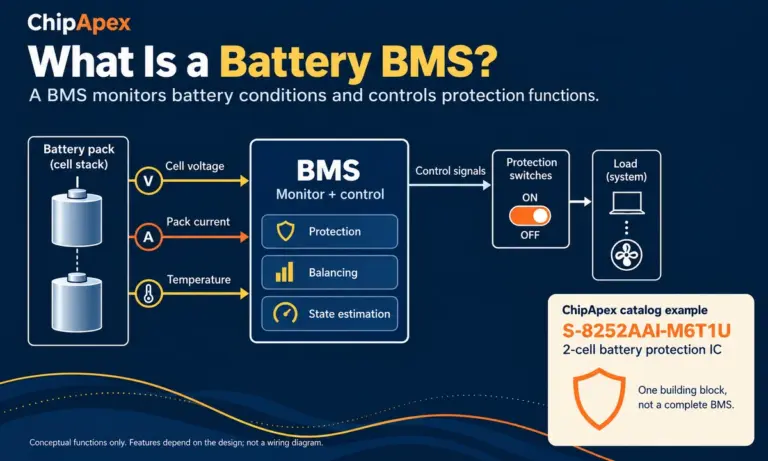
Learn what a battery BMS does, how protection differs from charging, and which pack specifications to check when sourcing BMS components through ChipApex.
Read More
Understand RF attenuator dB values, fixed and programmable types, impedance, power limits and noise tradeoffs before choosing parts for an RF signal path.
Read More
Plan electronics thermal management with power-loss estimates, thermal metrics, sensor placement and fan control. Check heat paths and validate your system.
Read More
Choose a vibration sensor for machine monitoring. Compare sensing methods, bandwidth, noise and mounting, then define the signal-chain requirements.
Read More
The activity of extra discounts on wholesale prices is in full swing…
Please fill in your contact information and we will send you the latest wholesale price list.






