 ChipApex | Global Electronic Components Supplier

SEARCH
Search Product
Search Post
— IC芯片 | 连接器 | 传感器 | 被动器件 —
Search productSearch post
— IC芯片 | 连接器 | 传感器 | 被动器件 —
Consult the customer manager about the wholesale price.
consultation hotline:86-132-6715-2157
email:[email protected]
Contact the product manager for consultation. One-stop consultation is available.
Do you want a lower wholesale price? Please send us your inquiry and we will reply immediately.
H11B1-X009T is listed in the Transistor, Photovoltaic Output Optoisolators range at ChipApex. The manufacturer field lists Vishay Semiconductor Opto Division. Its product description is OPTOISO 5.3KV DARL W/BASE 6-SMD. Review the specifications below when checking this part for your BOM.
The H11B1-X009T is a single-channel optocoupler manufactured by Vishay Semiconductor Opto Division. It features a DC input and a Darlington transistor output with base access, housed in a 6-pin SMD package. The device provides an isolation voltage of 5300Vrms. Key electrical parameters include a maximum collector-emitter voltage of 18V, a peak forward current of 25mA, and a minimum current transfer ratio of 500% at 1.6mA input. Typical switching times are 600ns for turn-on and 1.5µs for turn-off. The component operates within a temperature range of -55°C to 100°C.
Verify the specific suffix X009T against official Vishay documentation to confirm packaging and tape specifications. Confirm availability status as distribution data may indicate end-of-life or limited stock conditions. Ensure the selected variant matches the required lead time and reel quantity constraints for production integration.
Select this component when high current transfer ratio is required for driving loads directly. The integrated base allows for faster switching or linear operation compared to standard phototransistors. Verify that the 18V output voltage rating meets the circuit requirements. Consider thermal dissipation limits given the SMD package constraints.
This part belongs to the H11B series of Vishay optocouplers. It is distinct from the H11B2 model which also uses a Darlington output but may differ in specific electrical characteristics or pinout configurations. The X009T suffix denotes the specific surface-mount packaging format provided by the manufacturer.
Public confirmed substitutes include the H11B2-X009T. Verify compatibility regarding pinout and electrical ratings before substitution.
Explore related parts through Optocouplers, Optoisolators, Isolators, all product categories, ChipApex homepage.
 H11B1-X009T
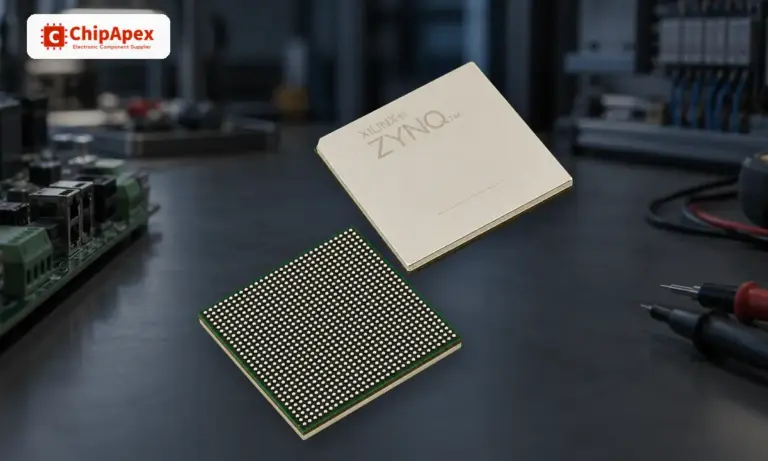
Learn what an integrated circuit is, how ICs work, the main types and the specs to check before choosing a part for your design…
Read More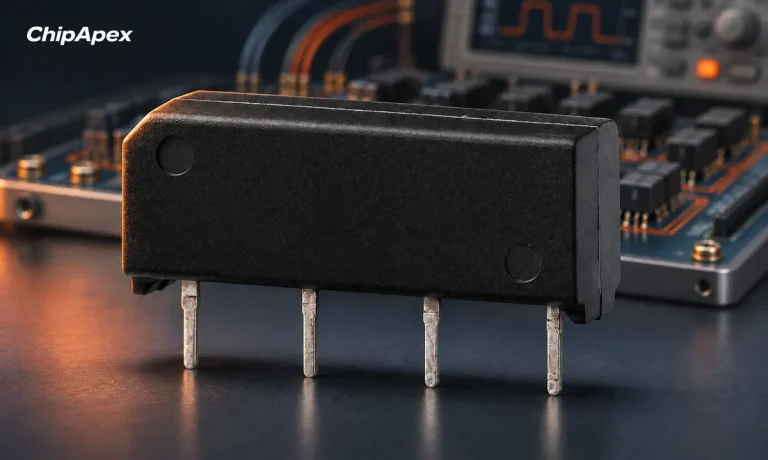
Choose a reed relay for signal switching. Understand hot and cold switching, leakage, contact resistance, isolation and measurement settling requirements.
Read More
H11B1-X009T is listed in the Transistor, Photovoltaic Output Optoisolators range at ChipApex. The manufacturer field lists Vishay Semiconductor Opto Division. Its product description is…
Read More
Compare thermistors, RTDs, thermocouples and temperature ICs. Learn how range, accuracy, response, interfaces and mounting affect component selection.
Read More
See how a MEMS gyroscope measures angular rate, why its angle estimate drifts, and which range, noise, interface and temperature specs to compare.
Read More
Select a bridge rectifier by reverse voltage, capacitor charging current, startup surge and cooling. Work through a stated DC voltage and ripple example.
Read More
H11B1-X009T is listed in the Transistor, Photovoltaic Output Optoisolators range at ChipApex. The manufacturer field lists Vishay Semiconductor Opto Division. Its product description is…
Read More
Choose a DIP switch by contact type, coded positions, footprint and signal ratings. Check logic polarity, assembly conditions and PCB configuration behavior.
Read More
H11B1-X009T is listed in the Transistor, Photovoltaic Output Optoisolators range at ChipApex. The manufacturer field lists Vishay Semiconductor Opto Division. Its product description is…
Read More
H11B1-X009T is listed in the Transistor, Photovoltaic Output Optoisolators range at ChipApex. The manufacturer field lists Vishay Semiconductor Opto Division. Its product description is…
Read More
H11B1-X009T is listed in the Transistor, Photovoltaic Output Optoisolators range at ChipApex. The manufacturer field lists Vishay Semiconductor Opto Division. Its product description is…
Read More
Learn what an IMU measures, how accelerometers and gyroscopes work together, why orientation estimates drift, and what to compare.
Read More
The activity of extra discounts on wholesale prices is in full swing…
Please fill in your contact information and we will send you the latest wholesale price list.






