 ChipApex | Global Electronic Components Supplier

SEARCH
Search Product
Search Post
— IC芯片 | 连接器 | 传感器 | 被动器件 —
Search productSearch post
— IC芯片 | 连接器 | 传感器 | 被动器件 —
Consult the customer manager about the wholesale price.
consultation hotline:86-132-6715-2157
email:[email protected]
Contact the product manager for consultation. One-stop consultation is available.
Do you want a lower wholesale price? Please send us your inquiry and we will reply immediately.
LM3671LC-1.8 is listed in the Voltage Regulators - DC DC Switching Regulators range at ChipApex. The manufacturer field lists National Semiconductor. Its product description is IC REG BUCK 1.8V 600MA 6USON. Review the specifications below when checking this part for your BOM.
The LM3671LC-1.8 is a step-down DC-DC converter manufactured by National Semiconductor, now part of Texas Instruments. It operates with an input voltage range of 2.7V to 5.5V and provides a fixed output voltage of 1.8V. The device delivers up to 600mA of load current at a switching frequency of 2MHz (maximum 2.6MHz). It features synchronous rectification for high efficiency and includes protection mechanisms such as overcurrent protection. The typical quiescent current is 16μA in PFM mode, reducing to 0.01μA in shutdown.
Verify the manufacturer origin, as National Semiconductor assets are managed by Texas Instruments. Confirm the specific suffix indicates the 1.8V fixed output variant. Ensure the package type matches the design requirements, typically SOT-23-5 or similar small footprints depending on the specific sub-version. Check RoHS compliance status if required by the target market regulations.
Select this component when a compact solution is needed for converting battery voltage to lower logic levels. The 2MHz frequency allows for smaller passive components compared to lower-frequency alternatives. Ensure the load current does not exceed 600mA. Consider thermal dissipation capabilities if operating near maximum current limits in enclosed spaces.
This part belongs to the LM3671 family of ultra-small step-down converters designed for portable applications. It was originally developed by National Semiconductor before their acquisition by Texas Instruments. The LC suffix typically denotes a specific package and temperature grade configuration within the broader product line.
LM3671LCX-1.8/NOPB: Direct equivalent from Texas Instruments with identical electrical specifications and pinout compatibility.
The maximum switching frequency is 2.6 MHz, with a typical value of 2 MHz.
No, the LM3671LC-1.8 variant provides a fixed 1.8V output. Adjustable versions exist within the LM3671 family but require different part numbers.
Explore related parts through Power Management (PMIC), Integrated Circuits (ICs), all product categories, ChipApex homepage.
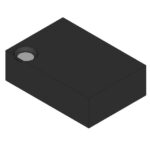 LM3671LC-1.8
Learn what data acquisition means, from sensors and conditioning to sampling and storage. Review channel timing, wiring, calibration and data quality.
Read More
LM3671LC-1.8 is listed in the Voltage Regulators - DC DC Switching Regulators range at ChipApex. The manufacturer field lists National Semiconductor. Its product description…
Read More
Compare RC, crystal and MEMS oscillator circuits. Check ppm, jitter, load capacitance, startup margin and output compatibility before choosing a clock source.
Read More
Learn how a diode conducts, how to identify anode and cathode, and when to choose rectifier, TVS, Zener or photodiode types for a circuit.
Read More
Find out when a bare shock switch needs a pull resistor, when an MCU internal pull-up is enough, and why sensor modules and piezo…
Read More
LM3671LC-1.8 is listed in the Voltage Regulators - DC DC Switching Regulators range at ChipApex. The manufacturer field lists National Semiconductor. Its product description…
Read More
Understand how oscillators generate timing signals, how they differ from crystals, and which frequency, output and stability specs matter when choosing one.
Read More
LM3671LC-1.8 is listed in the Voltage Regulators - DC DC Switching Regulators range at ChipApex. The manufacturer field lists National Semiconductor. Its product description…
Read More
LM3671LC-1.8 is listed in the Voltage Regulators - DC DC Switching Regulators range at ChipApex. The manufacturer field lists National Semiconductor. Its product description…
Read More
LM3671LC-1.8 is listed in the Voltage Regulators - DC DC Switching Regulators range at ChipApex. The manufacturer field lists National Semiconductor. Its product description…
Read More
Learn why PTC resistance rises with temperature, how it differs from NTC, and which ratings matter for sensing and protection.
Read More
Learn how rectifiers convert AC to DC, compare half-wave and bridge circuits, and select voltage, current, recovery and thermal ratings for your design.
Read More
The activity of extra discounts on wholesale prices is in full swing…
Please fill in your contact information and we will send you the latest wholesale price list.





