ChipApex | Global Electronic Components Supplier

SEARCH
Search Product
Search Post
— IC芯片 | 连接器 | 传感器 | 被动器件 —
Search productSearch post
— IC芯片 | 连接器 | 传感器 | 被动器件 —
Consult the customer manager about the wholesale price.
consultation hotline:86-132-6715-2157
email:[email protected]
Contact the product manager for consultation. One-stop consultation is available.
Do you want a lower wholesale price? Please send us your inquiry and we will reply immediately.
LM3671TL-ADJ/NOPB is listed in the Voltage Regulators - DC DC Switching Regulators range at ChipApex. The manufacturer field lists Texas Instruments. Its product description is IC REG BUCK ADJ 600MA 5DSBGA. Review the specifications below when checking this part for your BOM.
The LM3671TL-ADJ/NOPB is a synchronous step-down DC-DC converter manufactured by Texas Instruments. It operates with an input voltage range of 2.7 V to 5.5 V and delivers up to 600 mA of output current. The device features a fixed switching frequency of 2 MHz, enabling the use of compact external components. It provides an adjustable output voltage ranging from 1.1 V to 3.3 V. The component supports both Pulse Width Modulation (PWM) and Pulse Frequency Modulation (PFM) modes for optimized efficiency across load conditions.
Verify the specific suffix 'TL' corresponds to the DSBGA-5 package configuration required for your design. Confirm that the 'ADJ' designation matches the need for an adjustable output voltage rather than a fixed variant. Ensure compatibility with the -40°C to +85°C operating temperature range specified for this industrial grade part.
Select this component when a compact solution is needed for converting 2.7V to 5.5V inputs to lower voltages up to 600mA. The 2MHz frequency allows for smaller inductors compared to lower frequency alternatives. Choose the adjustable version if the target voltage falls outside standard fixed options or requires fine-tuning within the 1.1V to 3.3V range.
This part belongs to the LM3671 family of step-down converters designed for portable applications. It shares core architecture with other variants like the LM3671MF series but differs in packaging and specific electrical characteristics. The TL package indicates a specific surface-mount footprint distinct from the MF SOT-23-5 option.
LM3671MF-ADJ/NOPB offers similar electrical performance in a different SOT-23-5 package. LM3671TL-3.3/NOPB serves as a substitute if a fixed 3.3V output is acceptable instead of an adjustable one.
Explore related parts through Power Management (PMIC), Integrated Circuits (ICs), all product categories, ChipApex homepage.
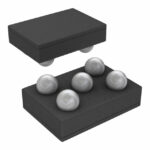 LM3671TL-ADJ/NOPB
Choose a rocker switch by AC/DC ratings, contact arrangement, illumination, panel fit and sealing. Get practical checks for engineering and component sourcing.
Read More
Learn how a pressure transducer converts pressure into voltage, current, or digital output, and compare pressure references and key selection specs.
Read More
Learn the relay definition, coil and contact operation, NO and NC forms, load ratings and suppression choices. Compare mechanical, reed and solid-state types.
Read More
LM3671TL-ADJ/NOPB is listed in the Voltage Regulators - DC DC Switching Regulators range at ChipApex. The manufacturer field lists Texas Instruments. Its product description…
Read More
Learn what data acquisition means, from sensors and conditioning to sampling and storage. Review channel timing, wiring, calibration and data quality.
Read More
Learn what an IMU measures, how accelerometers and gyroscopes work together, why orientation estimates drift, and what to compare.
Read More
LM3671TL-ADJ/NOPB is listed in the Voltage Regulators - DC DC Switching Regulators range at ChipApex. The manufacturer field lists Texas Instruments. Its product description…
Read More
Select MOV varistors by continuous voltage, clamping behavior, surge waveform and repetition. Check thermal disconnection, fuse coordination and replacements.
Read More
LM3671TL-ADJ/NOPB is listed in the Voltage Regulators - DC DC Switching Regulators range at ChipApex. The manufacturer field lists Texas Instruments. Its product description…
Read More
LM3671TL-ADJ/NOPB is listed in the Voltage Regulators - DC DC Switching Regulators range at ChipApex. The manufacturer field lists Texas Instruments. Its product description…
Read More
LM3671TL-ADJ/NOPB is listed in the Voltage Regulators - DC DC Switching Regulators range at ChipApex. The manufacturer field lists Texas Instruments. Its product description…
Read More
Understand how a comparator switches at a voltage threshold, why hysteresis prevents chatter, and which output and input specs matter.
Read More
The activity of extra discounts on wholesale prices is in full swing…
Please fill in your contact information and we will send you the latest wholesale price list.