 ChipApex | Global Electronic Components Supplier

SEARCH
Search Product
Search Post
— IC芯片 | 连接器 | 传感器 | 被动器件 —
Search productSearch post
— IC芯片 | 连接器 | 传感器 | 被动器件 —
Consult the customer manager about the wholesale price.
consultation hotline:86-132-6715-2157
email:[email protected]
Contact the product manager for consultation. One-stop consultation is available.
Do you want a lower wholesale price? Please send us your inquiry and we will reply immediately.
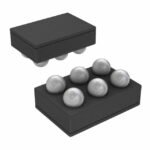
LM8801TME-1.2/NOPB is listed in the Voltage Regulators - DC DC Switching Regulators range at ChipApex. The manufacturer field lists Texas Instruments. Its product description is IC REG BUCK 1.2V 600MA 6DSBGA. Review the specifications below when checking this part for your BOM.
The LM8801TME-1.2/NOPB is a fixed-output synchronous buck switching regulator manufactured by Texas Instruments. It provides a fixed 1.2V output with a maximum load current of 600mA. The device operates from an input voltage range of 2.3V to 5.5V and utilizes a high-frequency 6MHz switching architecture. It features a compact 6-pin WFBGA (DSBGA) surface-mount package. The component supports operation across an ambient temperature range of -30°C to +85°C.
Verify the specific suffix '1.2' confirms the fixed 1.2V output voltage variant, as the LM8801 family includes other voltage options. Ensure the 'TME' designation matches the required 6-WFBGA package type. Confirm 'NOPB' indicates lead-free compliance with RoHS standards. Cross-reference the manufacturer part number against official datasheets to validate pinout and thermal characteristics before integration.
Select this component when a fixed 1.2V rail is required at up to 600mA. The 6MHz frequency allows for smaller inductors compared to lower-frequency alternatives. Verify that the input supply remains within the 2.3V to 5.5V range. Consider the 600mA current limit for load requirements. The fixed output eliminates the need for external feedback resistors, reducing bill of materials complexity.
This part belongs to the LM8801 series of high-performance synchronous buck converters. The series is characterized by its ability to operate at high switching frequencies while maintaining small solution sizes. The LM8801 family offers various fixed output voltages to suit different digital logic levels. The TME package variant provides a compact footprint suitable for space-constrained mobile applications.
LM8801TME-2.9/NOPB: Same package and topology but provides a fixed 2.9V output instead of 1.2V.
Explore related parts through Power Management (PMIC), Integrated Circuits (ICs), all product categories, ChipApex homepage.
 LM8801TME-1.2/NOPB

Find out when a bare shock switch needs a pull resistor, when an MCU internal pull-up is enough, and why sensor modules and piezo…
Read More
Understand load cell sensor output, bridge wiring and calibration. Learn how mV/V sensitivity, mechanics and ADC noise affect measurement accuracy.
Read More
LM8801TME-1.2/NOPB is listed in the Voltage Regulators - DC DC Switching Regulators range at ChipApex. The manufacturer field lists Texas Instruments. Its product description…
Read More
LM8801TME-1.2/NOPB is listed in the Voltage Regulators - DC DC Switching Regulators range at ChipApex. The manufacturer field lists Texas Instruments. Its product description…
Read More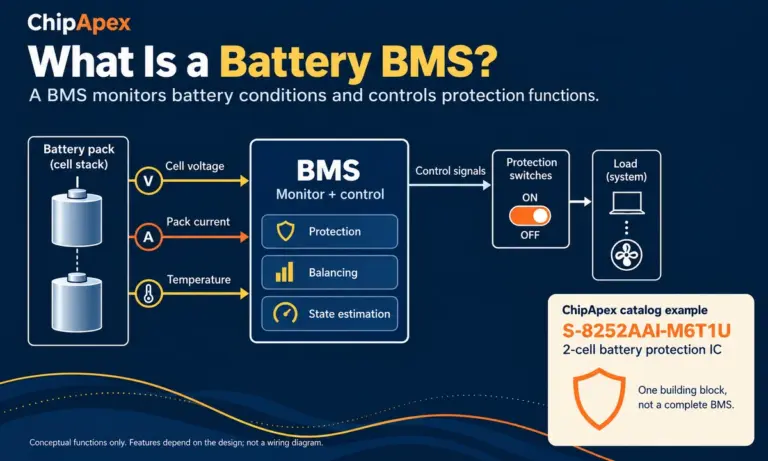
Learn what a battery BMS does, how protection differs from charging, and which pack specifications to check when sourcing BMS components through ChipApex.
Read More
LM8801TME-1.2/NOPB is listed in the Voltage Regulators - DC DC Switching Regulators range at ChipApex. The manufacturer field lists Texas Instruments. Its product description…
Read More
LM8801TME-1.2/NOPB is listed in the Voltage Regulators - DC DC Switching Regulators range at ChipApex. The manufacturer field lists Texas Instruments. Its product description…
Read More
Learn what an integrated circuit is, how ICs work, the main types and the specs to check before choosing a part for your design…
Read More
Compare gas sensor technologies, cross-sensitivity and calibration needs. Define the gas, range and environment before choosing a sensing component.
Read More
See how a MEMS gyroscope measures angular rate, why its angle estimate drifts, and which range, noise, interface and temperature specs to compare.
Read More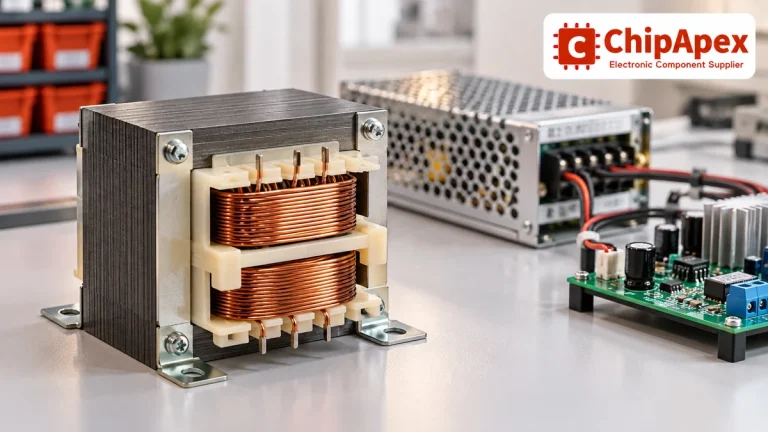
Select power transformers by input frequency, secondary VA, rectifier load, isolation, regulation and inrush. Build a clearer specification for your next RFQ.
Read More
Understand how a comparator switches at a voltage threshold, why hysteresis prevents chatter, and which output and input specs matter.
Read More
The activity of extra discounts on wholesale prices is in full swing…
Please fill in your contact information and we will send you the latest wholesale price list.





