 ChipApex | Global Electronic Components Supplier

SEARCH
Search Product
Search Post
— IC芯片 | 连接器 | 传感器 | 被动器件 —
Search productSearch post
— IC芯片 | 连接器 | 传感器 | 被动器件 —
Consult the customer manager about the wholesale price.
consultation hotline:86-132-6715-2157
email:[email protected]
Contact the product manager for consultation. One-stop consultation is available.
Do you want a lower wholesale price? Please send us your inquiry and we will reply immediately.
MCP2561-H/MF is listed in the Drivers, Receivers, Transceivers range at ChipApex. The manufacturer field lists Microchip Technology. Its product description is IC TRANSCEIVER HALF 1/1 8DFN. Review the specifications below when checking this part for your BOM.
The MCP2561-H/MF is a high-speed CAN transceiver from Microchip Technology, designed for automotive and industrial applications. It supports data rates up to 1 Mb/s and operates within an extended temperature range of -40°C to +150°C. The device features a SPLIT pin for common mode stabilization in biased split-termination schemes. Electrical characteristics include a supply voltage range of 4.5V to 5.5V for VDD and 1.8V to 5.5V for VIO (internally connected to VDD in this model). Standby current is typically 5 µA. It provides high ESD protection on CANH and CANL pins, meeting IEC61000-4-2 standards up to ±14 kV.
Verify the specific ordering suffix against the manufacturer's product identification system to ensure correct package type and temperature rating. Confirm that the component meets all relevant automotive design requirements and RoHS compliance standards before integration into production designs.
Select this component when interfacing with microcontrollers operating at standard 5V logic levels or when utilizing biased split termination networks. Ensure the application environment stays within the specified -40°C to +150°C operating range and requires single-transceiver functionality rather than dual-channel solutions.
This part belongs to the MCP2561/2 family of second-generation high-speed CAN transceivers. It serves as the physical layer interface between CAN protocol controllers and the two-wire CAN bus, offering fault tolerance and electromagnetic compatibility suitable for demanding automotive and industrial network topologies.
The MCP2561-E/MF offers identical functionality but with a lower operating temperature range of -40°C to +125°C. Verify if the extended temperature capability of the -H suffix is strictly required for the target application environment.
Explore related parts through Interface, Integrated Circuits (ICs), all product categories, ChipApex homepage.
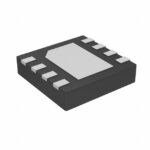 MCP2561-H/MF
 is listed in the Drivers, Receivers, Transceivers range at ChipApex. The manufacturer field lists Microchip Technology. Its product description is IC TRANSCEIVER HALF…
Read More
See how a MEMS gyroscope measures angular rate, why its angle estimate drifts, and which range, noise, interface and temperature specs to compare.
Read More
MCP2561-H/MF is listed in the Drivers, Receivers, Transceivers range at ChipApex. The manufacturer field lists Microchip Technology. Its product description is IC TRANSCEIVER HALF…
Read More
MCP2561-H/MF is listed in the Drivers, Receivers, Transceivers range at ChipApex. The manufacturer field lists Microchip Technology. Its product description is IC TRANSCEIVER HALF…
Read More
Choose logic inverter ICs by thresholds, supply, output drive and delay. Compare standard and Schmitt-trigger inputs, power sequencing and replacement checks.
Read More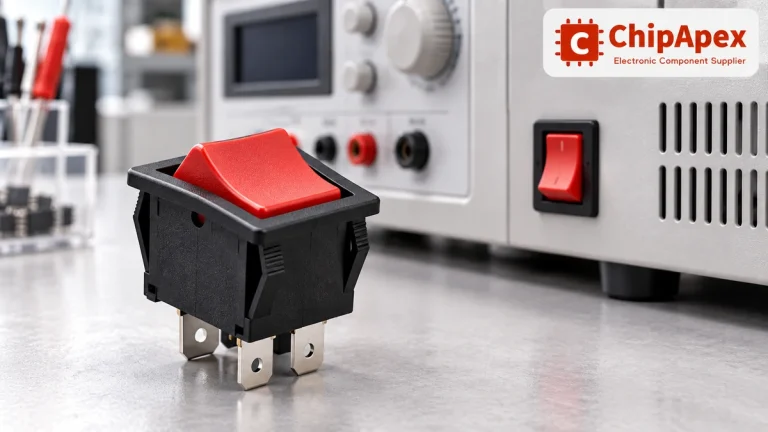
Choose a rocker switch by AC/DC ratings, contact arrangement, illumination, panel fit and sealing. Get practical checks for engineering and component sourcing.
Read More
Understand how oscillators generate timing signals, how they differ from crystals, and which frequency, output and stability specs matter when choosing one.
Read More
MCP2561-H/MF is listed in the Drivers, Receivers, Transceivers range at ChipApex. The manufacturer field lists Microchip Technology. Its product description is IC TRANSCEIVER HALF…
Read More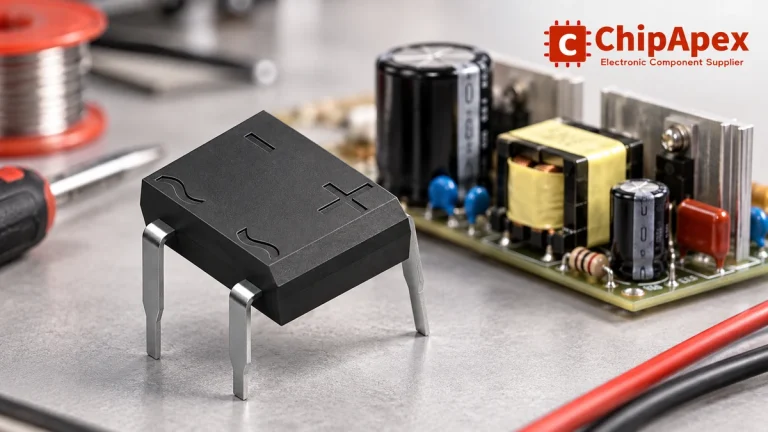
Select a bridge rectifier by reverse voltage, capacitor charging current, startup surge and cooling. Work through a stated DC voltage and ripple example.
Read More
Learn what a battery BMS does, how protection differs from charging, and which pack specifications to check when sourcing BMS components through ChipApex.
Read More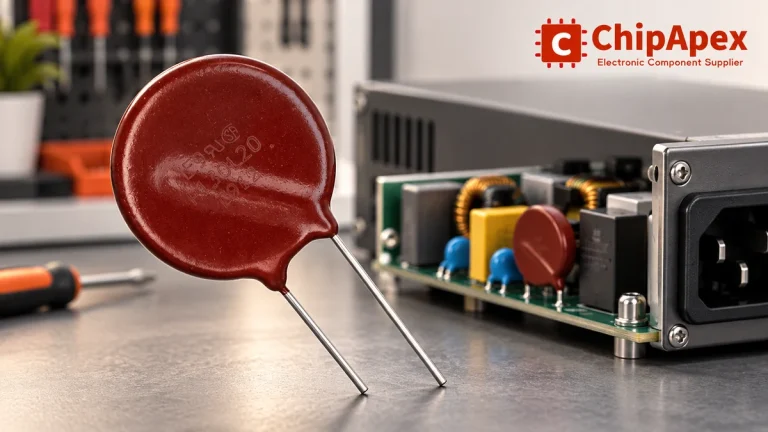
Select MOV varistors by continuous voltage, clamping behavior, surge waveform and repetition. Check thermal disconnection, fuse coordination and replacements.
Read More
Choose an AC to DC converter by input range, output demand, isolation, efficiency and thermal derating. Compare architectures and check installation needs.
Read More
The activity of extra discounts on wholesale prices is in full swing…
Please fill in your contact information and we will send you the latest wholesale price list.





