 ChipApex | Global Electronic Components Supplier

SEARCH
Search Product
Search Post
— IC芯片 | 连接器 | 传感器 | 被动器件 —
Search productSearch post
— IC芯片 | 连接器 | 传感器 | 被动器件 —
Consult the customer manager about the wholesale price.
consultation hotline:86-132-6715-2157
email:[email protected]
Contact the product manager for consultation. One-stop consultation is available.
Do you want a lower wholesale price? Please send us your inquiry and we will reply immediately.
MCP4151-503E/SN is listed in the Digital Potentiometers range at ChipApex. The manufacturer field lists Microchip Technology. Its product description is IC DGTL POT 50KOHM 257TAP 8SOIC. Review the specifications below when checking this part for your BOM.
The MCP4151-503E/SN is a single-channel digital potentiometer manufactured by Microchip Technology. It features an 8-bit resistor network providing 256 resistors and 257 steps, with a nominal resistance (R_AB) of 50 kΩ and a tolerance of ±20%. The device operates on a supply voltage (V_DD) ranging from 1.8V to 5.5V and utilizes a standard SPI serial interface for control. It employs volatile RAM memory, resetting the wiper to mid-scale upon power-up or brown-out reset. Key electrical characteristics include a typical wiper resistance (R_W) of 75 Ω, a bandwidth of 200 kHz at 50 kΩ, and high-voltage tolerant digital inputs up to 12.5V.
Verify the specific suffix 'SN' corresponds to the 8-lead SOIC package when sourcing. Confirm that the 'E' designation indicates compliance with RoHS standards. Ensure the order quantity matches the manufacturer's standard packaging requirements, as this component is typically supplied in tubes.
Select the MCP4151-503E/SN when a single potentiometer with 50 kΩ resistance and 8-bit resolution is required. This model is suitable for applications needing high-voltage tolerant digital interfaces. For rheostat configurations, consider the MCP4152 variant. If non-volatile memory retention is necessary across power cycles, the MCP4161 series should be evaluated instead.
This component belongs to the MCP41XX family of single-channel SPI digital potentiometers. It shares architectural similarities with the MCP42XX dual-channel series but provides only one resistor network. The part number structure indicates the resistance value (503 = 50 kΩ) and the package type (SN = SOIC).
Direct functional substitutes within the same family include the MCP4151-103E/SN (10 kΩ), MCP4151-502E/SN (5 kΩ), and MCP4151-104E/SN (100 kΩ). These parts maintain identical pinouts and specifications except for the total end-to-end resistance.
Explore related parts through Data Acquisition, Integrated Circuits (ICs), all product categories, ChipApex homepage.
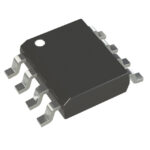 MCP4151-503E/SN

Learn how a pressure transducer converts pressure into voltage, current, or digital output, and compare pressure references and key selection specs.
Read More
Select MOV varistors by continuous voltage, clamping behavior, surge waveform and repetition. Check thermal disconnection, fuse coordination and replacements.
Read More
MCP4151-503E/SN is listed in the Digital Potentiometers range at ChipApex. The manufacturer field lists Microchip Technology. Its product description is IC DGTL POT 50KOHM…
Read More
Understand how a comparator switches at a voltage threshold, why hysteresis prevents chatter, and which output and input specs matter.
Read More
Learn what data acquisition means, from sensors and conditioning to sampling and storage. Review channel timing, wiring, calibration and data quality.
Read More
Select a common mode choke using noise frequency, current, insulation and signal integrity. Understand impedance curves, layout and filter limitations.
Read More
MCP4151-503E/SN is listed in the Digital Potentiometers range at ChipApex. The manufacturer field lists Microchip Technology. Its product description is IC DGTL POT 50KOHM…
Read More
Choose LED drivers by current, string voltage, dimming and thermal limits. Understand constant-current operation and the checks needed for your load.
Read More
Learn why PTC resistance rises with temperature, how it differs from NTC, and which ratings matter for sensing and protection.
Read More
Learn what an integrated circuit is, how ICs work, the main types and the specs to check before choosing a part for your design…
Read More
Choose a DIP switch by contact type, coded positions, footprint and signal ratings. Check logic polarity, assembly conditions and PCB configuration behavior.
Read More
Choose a vibration sensor for machine monitoring. Compare sensing methods, bandwidth, noise and mounting, then define the signal-chain requirements.
Read More
The activity of extra discounts on wholesale prices is in full swing…
Please fill in your contact information and we will send you the latest wholesale price list.





