 ChipApex | Global Electronic Components Supplier

SEARCH
Search Product
Search Post
— IC芯片 | 连接器 | 传感器 | 被动器件 —
Search productSearch post
— IC芯片 | 连接器 | 传感器 | 被动器件 —
Consult the customer manager about the wholesale price.
consultation hotline:86-132-6715-2157
email:[email protected]
Contact the product manager for consultation. One-stop consultation is available.
Do you want a lower wholesale price? Please send us your inquiry and we will reply immediately.
SMBG5945C/TR13 is listed in the Single Zener Diodes range at ChipApex. The manufacturer field lists Microsemi Corporation. Its product description is DIODE ZENER 68V 2W DO214AA. Review the specifications below when checking this part for your BOM.
The SMBG5945C/TR13 is a single Zener diode manufactured by Microsemi Corporation, designed for surface-mount applications in the DO-214AA (SMBG) package. It features a nominal Zener voltage of 68 V with a tight tolerance of ±2%. The device supports a maximum power dissipation of 2 W and operates within a temperature range of -65°C to +150°C. Key electrical characteristics include a reverse leakage current of 1 µA at 51.2 V and a forward voltage of 1.2 V at 200 mA.
Verify component authenticity through official Microsemi channels or authorized distributors. Confirm RoHS compliance status as historical data indicates potential non-compliance for this specific suffix. Check for End-of-Life (EOL) notifications, as the SMBG59xx series has been subject to discontinuation notices. Ensure the TR13 tape-and-reel specification matches production requirements.
Select this component when precise 68 V regulation is required in a 2 W surface-mount form factor. The ±2% tolerance makes it suitable for applications demanding tighter voltage stability than standard ±5% devices. Consider the DO-214AA footprint compatibility during PCB layout. Evaluate thermal management needs given the 150°C maximum junction temperature rating.
This part belongs to the SMBG5913-5956,e3 series of single Zener diodes from Microsemi. These components are engineered for general-purpose voltage regulation and protection in compact electronic assemblies. The SMBG package provides a balance of power handling and space efficiency for surface-mount technology implementations.
Publicly confirmed substitute part numbers for SMBG5945C/TR13 were not identified in the provided source material. Cross-reference with SMBG5945BE3/TR13 or SMBG5945AE3/TR13 only if tolerance differences (±10%) are acceptable.
Explore related parts through Zener, Diodes, Discrete Semiconductor Products, all product categories.
 SMBG5945C/TR13

Understand how oscillators generate timing signals, how they differ from crystals, and which frequency, output and stability specs matter when choosing one.
Read More
Learn how a pressure transducer converts pressure into voltage, current, or digital output, and compare pressure references and key selection specs.
Read More
Select a bridge rectifier by reverse voltage, capacitor charging current, startup surge and cooling. Work through a stated DC voltage and ripple example.
Read More
SMBG5945C/TR13 is listed in the Single Zener Diodes range at ChipApex. The manufacturer field lists Microsemi Corporation. Its product description is DIODE ZENER 68V…
Read More
SMBG5945C/TR13 is listed in the Single Zener Diodes range at ChipApex. The manufacturer field lists Microsemi Corporation. Its product description is DIODE ZENER 68V…
Read More
Learn what data acquisition means, from sensors and conditioning to sampling and storage. Review channel timing, wiring, calibration and data quality.
Read More
SMBG5945C/TR13 is listed in the Single Zener Diodes range at ChipApex. The manufacturer field lists Microsemi Corporation. Its product description is DIODE ZENER 68V…
Read More
SMBG5945C/TR13 is listed in the Single Zener Diodes range at ChipApex. The manufacturer field lists Microsemi Corporation. Its product description is DIODE ZENER 68V…
Read More
Choose a DIP switch by contact type, coded positions, footprint and signal ratings. Check logic polarity, assembly conditions and PCB configuration behavior.
Read More
SMBG5945C/TR13 is listed in the Single Zener Diodes range at ChipApex. The manufacturer field lists Microsemi Corporation. Its product description is DIODE ZENER 68V…
Read More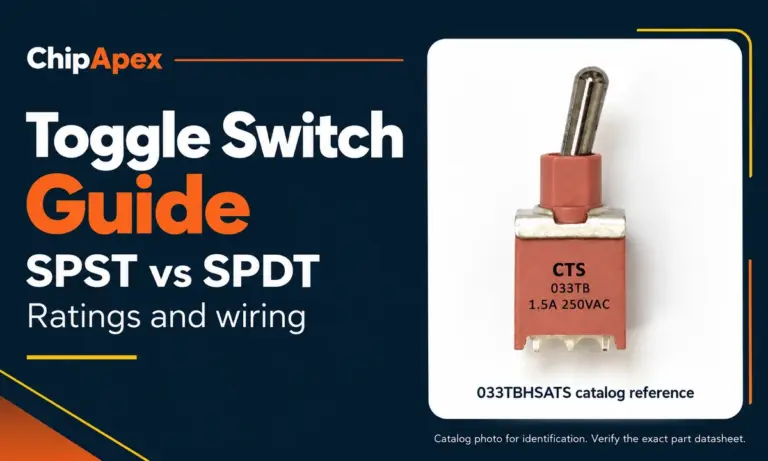
Compare SPST and SPDT toggle switches, understand AC/DC ratings, and follow wiring examples. Check contact action, mounting and parts in the ChipApex catalog.
Read More
Learn what an IMU measures, how accelerometers and gyroscopes work together, why orientation estimates drift, and what to compare.
Read More
The activity of extra discounts on wholesale prices is in full swing…
Please fill in your contact information and we will send you the latest wholesale price list.





