 ChipApex | Global Electronic Components Supplier

SEARCH
Search Product
Search Post
— IC芯片 | 连接器 | 传感器 | 被动器件 —
Search productSearch post
— IC芯片 | 连接器 | 传感器 | 被动器件 —
Consult the customer manager about the wholesale price.
consultation hotline:86-132-6715-2157
email:[email protected]
Contact the product manager for consultation. One-stop consultation is available.
Do you want a lower wholesale price? Please send us your inquiry and we will reply immediately.
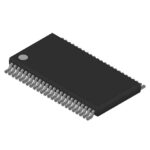
SN74ABT162245DGG is listed in the Buffers, Drivers, Receivers, Transceivers range at ChipApex. The manufacturer field lists Texas Instruments. Its product description is IC TXRX NON-INVERT 5.5V. Review the specifications below when checking this part for your BOM.
The SN74ABT162245DGG is a 16-bit dual-octal non-inverting bus transceiver manufactured by Texas Instruments. It operates within a voltage range of 2.5 V to 3.3 V or 3.3 V to 5 V, facilitating level shifting between different logic families. The device features a TSSOP-48 package and supports surface mount installation. Key electrical parameters include a propagation delay of 5.8 ns, a maximum supply voltage of 5.5 V, and a minimum operating temperature of -40°C with a maximum of +85°C. It draws a typical operating current of 40 uA and provides 3-state outputs for effective bus management in high-speed digital systems.
Verify the specific suffix against the manufacturer's official documentation to confirm pin compatibility and electrical characteristics. Ensure the component meets RoHS standards required for your region. Cross-reference the datasheet revision date to validate performance specifications before integration into production designs.
Select this component when designing systems that require interfacing between 3.3-V and 5-V logic levels with minimal delay. Consider the TSSOP-48 package constraints for PCB layout. Evaluate the 40-uA quiescent current against system power budgets for battery-operated devices.
This part belongs to the ALVC family of logic integrated circuits from Texas Instruments. It is designed for high-speed operations while maintaining low power dissipation. The device serves as a critical interface solution in mixed-voltage environments common in modern electronic architectures.
Consult the manufacturer's obsolescence notices for direct replacements. Verify pin-to-pin compatibility and electrical parameter equivalence with alternative parts from the same logic family.
Explore related parts through Logic, Integrated Circuits (ICs), all product categories, ChipApex homepage.
 SN74ABT162245DGG

Understand how oscillators generate timing signals, how they differ from crystals, and which frequency, output and stability specs matter when choosing one.
Read More
See how a MEMS gyroscope measures angular rate, why its angle estimate drifts, and which range, noise, interface and temperature specs to compare.
Read More
SN74ABT162245DGG is listed in the Buffers, Drivers, Receivers, Transceivers range at ChipApex. The manufacturer field lists Texas Instruments. Its product description is IC TXRX…
Read More
SN74ABT162245DGG is listed in the Buffers, Drivers, Receivers, Transceivers range at ChipApex. The manufacturer field lists Texas Instruments. Its product description is IC TXRX…
Read More
Select a bridge rectifier by reverse voltage, capacitor charging current, startup surge and cooling. Work through a stated DC voltage and ripple example.
Read More
Compare RC, crystal and MEMS oscillator circuits. Check ppm, jitter, load capacitance, startup margin and output compatibility before choosing a clock source.
Read More
SN74ABT162245DGG is listed in the Buffers, Drivers, Receivers, Transceivers range at ChipApex. The manufacturer field lists Texas Instruments. Its product description is IC TXRX…
Read More
Find out when a bare shock switch needs a pull resistor, when an MCU internal pull-up is enough, and why sensor modules and piezo…
Read More
SN74ABT162245DGG is listed in the Buffers, Drivers, Receivers, Transceivers range at ChipApex. The manufacturer field lists Texas Instruments. Its product description is IC TXRX…
Read More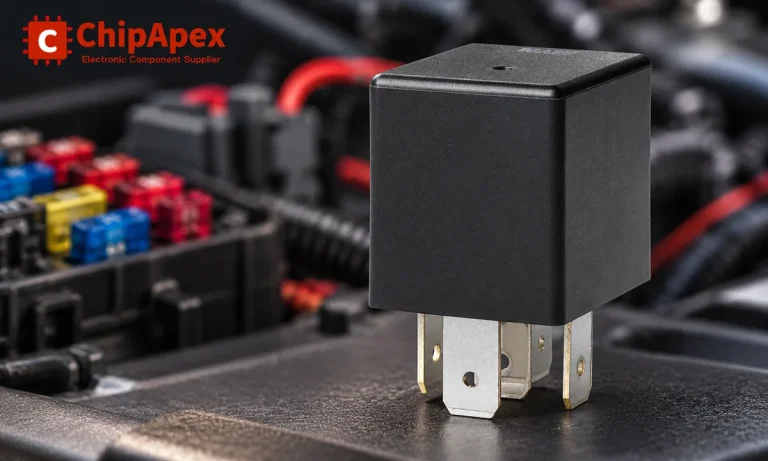
Learn the relay definition, coil and contact operation, NO and NC forms, load ratings and suppression choices. Compare mechanical, reed and solid-state types.
Read More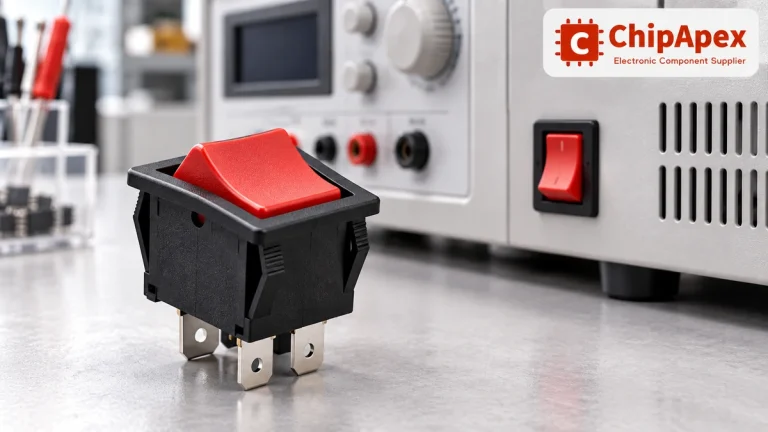
Choose a rocker switch by AC/DC ratings, contact arrangement, illumination, panel fit and sealing. Get practical checks for engineering and component sourcing.
Read More
Learn what an IMU measures, how accelerometers and gyroscopes work together, why orientation estimates drift, and what to compare.
Read More
The activity of extra discounts on wholesale prices is in full swing…
Please fill in your contact information and we will send you the latest wholesale price list.





