 ChipApex | Global Electronic Components Supplier

SEARCH
Search Product
Search Post
— IC芯片 | 连接器 | 传感器 | 被动器件 —
Search productSearch post
— IC芯片 | 连接器 | 传感器 | 被动器件 —
Consult the customer manager about the wholesale price.
consultation hotline:86-132-6715-2157
email:[email protected]
Contact the product manager for consultation. One-stop consultation is available.
Do you want a lower wholesale price? Please send us your inquiry and we will reply immediately.
SN74BCT240DBR is listed in the Buffers, Drivers, Receivers, Transceivers range at ChipApex. The manufacturer field lists Texas Instruments. Its product description is IC BUFFER INVERT 5.5V 20SSOP. Review the specifications below when checking this part for your BOM.
The SN74BCT240DBR is an octal buffer and line driver manufactured by Texas Instruments, belonging to the BCT logic series. It features eight inverting channels with three-state outputs housed in a 20-pin SOIC package. The device operates within a supply voltage range of 4.5 V to 5.5 V. Key electrical specifications include a high-level output current of -15 mA and a low-level output current of 64 mA. Propagation delay is specified at 4.8 ns when operating at 5 V. The component supports surface-mount installation and functions reliably across a temperature range from 0°C to +70°C.
Verify the specific ordering suffix 'DBR' against the manufacturer's official documentation to confirm the tape-and-reel packaging configuration. Ensure the selected variant matches the required operational temperature range and pinout compatibility for your printed circuit board design before finalizing procurement.
Select this component for applications requiring octal data buffering with three-state control on standard buses. Consider the BCT series characteristics for improved speed compared to legacy TTL while maintaining compatible input and output levels. Evaluate the package constraints and thermal requirements to ensure suitability for the target system environment.
This part belongs to the SN74BCT family of logic integrated circuits produced by Texas Instruments. The BCT series combines the speed benefits of BiCMOS technology with the compatibility of standard TTL inputs. This specific model serves as an octal buffer, providing signal integrity and drive strength for digital logic interfaces in various electronic systems.
Consult official substitution guides for equivalent octal buffers with three-state outputs. Verify that any alternative part maintains matching voltage ranges, propagation delays, and package dimensions to ensure functional compatibility without redesigning the host circuit.
Explore related parts through Logic, Integrated Circuits (ICs), all product categories, ChipApex homepage.
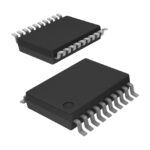 SN74BCT240DBR
Understand UART protocol framing, baud rate and electrical interfaces. Learn 8N1 timing, TX/RX wiring, buffering and practical troubleshooting steps.
Read More
Understand RF attenuator dB values, fixed and programmable types, impedance, power limits and noise tradeoffs before choosing parts for an RF signal path.
Read More
SN74BCT240DBR is listed in the Buffers, Drivers, Receivers, Transceivers range at ChipApex. The manufacturer field lists Texas Instruments. Its product description is IC BUFFER…
Read More
SN74BCT240DBR is listed in the Buffers, Drivers, Receivers, Transceivers range at ChipApex. The manufacturer field lists Texas Instruments. Its product description is IC BUFFER…
Read More
Learn how a JFET works and how to compare bias, leakage, noise and pinout. Review practical selection questions for high-impedance analog circuits.
Read More
Choose an ADC converter by resolution, sample rate, noise and input design. Review practical tradeoffs and prepare component requirements for ChipApex.
Read More
Learn how rectifiers convert AC to DC, compare half-wave and bridge circuits, and select voltage, current, recovery and thermal ratings for your design.
Read More
Learn what an IMU measures, how accelerometers and gyroscopes work together, why orientation estimates drift, and what to compare.
Read More
Select power transformers by input frequency, secondary VA, rectifier load, isolation, regulation and inrush. Build a clearer specification for your next RFQ.
Read More
See how a MEMS gyroscope measures angular rate, why its angle estimate drifts, and which range, noise, interface and temperature specs to compare.
Read More
See when an inductor behaves linearly, how DC bias and saturation reduce inductance, and which current and temperature curves to check.
Read More
Select a common mode choke using noise frequency, current, insulation and signal integrity. Understand impedance curves, layout and filter limitations.
Read More
The activity of extra discounts on wholesale prices is in full swing…
Please fill in your contact information and we will send you the latest wholesale price list.





