 ChipApex | Global Electronic Components Supplier

SEARCH
Search Product
Search Post
— IC芯片 | 连接器 | 传感器 | 被动器件 —
Search productSearch post
— IC芯片 | 连接器 | 传感器 | 被动器件 —
Consult the customer manager about the wholesale price.
consultation hotline:86-132-6715-2157
email:[email protected]
Contact the product manager for consultation. One-stop consultation is available.
Do you want a lower wholesale price? Please send us your inquiry and we will reply immediately.
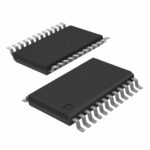
SN74GTLPH306PWR is listed in the Translators, Level Shifters range at ChipApex. The manufacturer field lists Texas Instruments. Its product description is IC TRANSLATOR BIDIR 24TSSOP. Review the specifications below when checking this part for your BOM.
The SN74GTLPH306PWR is a dual 1:2 GTL+ bus splitter manufactured by Texas Instruments. It features two independent buffers with separate output enable inputs, designed to split a single GTL+ signal into two paths while maintaining signal integrity. The device operates at a supply voltage of 3.3 V and supports data rates up to 800 Mbps. It utilizes a TSSOP-14 package, providing a compact solution for high-speed digital applications requiring GTL+ termination compatibility.
Verify the specific suffix 'PWR' corresponds to the TSSOP-14 package and tape-and-reel packaging configuration as per the manufacturer's official documentation. Confirm that the operating temperature range meets your system requirements before procurement. Ensure compatibility with existing GTL+ termination schemes in your design.
Select this component when a dual-channel GTL+ buffer is required for splitting signals in high-speed digital circuits. Consider the TSSOP-14 package size constraints and the need for independent output enable controls. Verify that the 3.3 V supply voltage aligns with your system's power architecture and that the 800 Mbps speed capability suffices for your data rate needs.
This part belongs to the SN74GTL family of logic devices, specifically optimized for GTL+ (Gunning Transceiver Logic Plus) applications. It serves as a critical interface component in systems transitioning from older logic families to high-speed, low-voltage standards. The device complements other GTL drivers and receivers within the same ecosystem.
Check for direct pin-compatible alternatives within the SN74GTL series that offer similar buffering capabilities. Verify if updated revisions or enhanced performance variants are available from Texas Instruments. Ensure any substitute maintains GTL+ compatibility and the same package footprint.
Explore related parts through Logic, Integrated Circuits (ICs), all product categories, ChipApex homepage.
 SN74GTLPH306PWR
Understand UART protocol framing, baud rate and electrical interfaces. Learn 8N1 timing, TX/RX wiring, buffering and practical troubleshooting steps.
Read More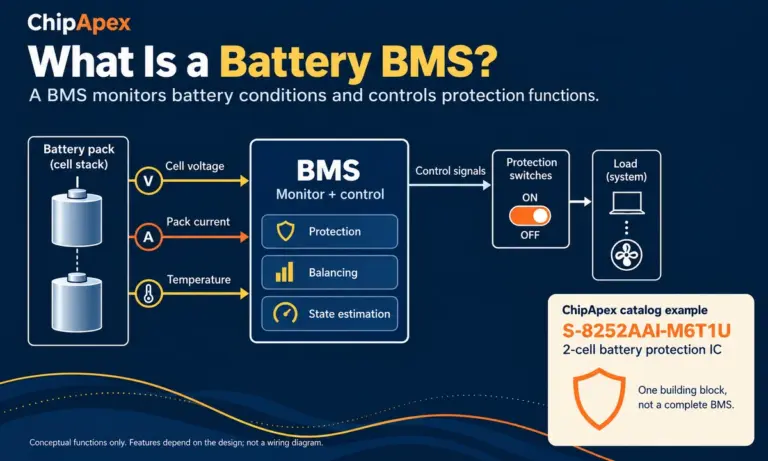
Learn what a battery BMS does, how protection differs from charging, and which pack specifications to check when sourcing BMS components through ChipApex.
Read More
SN74GTLPH306PWR is listed in the Translators, Level Shifters range at ChipApex. The manufacturer field lists Texas Instruments. Its product description is IC TRANSLATOR BIDIR…
Read More
See when an inductor behaves linearly, how DC bias and saturation reduce inductance, and which current and temperature curves to check.
Read More
Learn how a diode conducts, how to identify anode and cathode, and when to choose rectifier, TVS, Zener or photodiode types for a circuit.
Read More
Understand how an LDO regulates voltage. Check dropout, noise, PSRR, output capacitors and heat before selecting a low-dropout regulator for your circuit.
Read More
SN74GTLPH306PWR is listed in the Translators, Level Shifters range at ChipApex. The manufacturer field lists Texas Instruments. Its product description is IC TRANSLATOR BIDIR…
Read More
SN74GTLPH306PWR is listed in the Translators, Level Shifters range at ChipApex. The manufacturer field lists Texas Instruments. Its product description is IC TRANSLATOR BIDIR…
Read More
Choose a DIP switch by contact type, coded positions, footprint and signal ratings. Check logic polarity, assembly conditions and PCB configuration behavior.
Read More
Choose LED drivers by current, string voltage, dimming and thermal limits. Understand constant-current operation and the checks needed for your load.
Read More
SN74GTLPH306PWR is listed in the Translators, Level Shifters range at ChipApex. The manufacturer field lists Texas Instruments. Its product description is IC TRANSLATOR BIDIR…
Read More
Learn how CPLDs implement hardware logic, compare them with FPGAs and MCUs, and check timing, I/O voltage, startup behavior and programming requirements.
Read More
The activity of extra discounts on wholesale prices is in full swing…
Please fill in your contact information and we will send you the latest wholesale price list.






