 ChipApex | Global Electronic Components Supplier

SEARCH
Search Product
Search Post
— IC芯片 | 连接器 | 传感器 | 被动器件 —
Search productSearch post
— IC芯片 | 连接器 | 传感器 | 被动器件 —
Consult the customer manager about the wholesale price.
consultation hotline:86-132-6715-2157
email:[email protected]
Contact the product manager for consultation. One-stop consultation is available.
Do you want a lower wholesale price? Please send us your inquiry and we will reply immediately.
SN74HCS165QDYYRQ1 is listed in the Shift Registers range at ChipApex. The manufacturer field lists Texas Instruments. Its product description is AUTOMOTIVE 8-BIT PARALLEL-LOAD S. Review the specifications below when checking this part for your BOM.
The SN74HCS165QDYYRQ1 is an automotive-grade, 8-bit parallel-load shift register from Texas Instruments. It operates within a supply voltage range of 2 V to 6 V and supports an ambient temperature range of -40°C to +125°C. The device features Schmitt-trigger inputs for noise rejection and balanced CMOS push-pull outputs capable of ±7.8 mA drive current at 6 V. Propagation delay ranges from 14 ns to 19 ns depending on voltage and temperature. It is housed in a 16-pin SOT-23-THIN package.
Verify the specific ordering suffix matches the required package type, as the SN74HCS165-Q1 family includes various packages such as TSSOP, SOIC, WQFN, and SOT-23-THIN. Confirm that the Q1 designation aligns with automotive qualification requirements. Ensure the selected variant meets the thermal and electrical specifications necessary for the intended operating environment.
Select this component when expanding microcontroller I/O ports via serial interfaces is required. The Schmitt-trigger inputs are suitable for environments with signal noise or slow transition times. Verify that the output drive capability meets load requirements without exceeding absolute maximum ratings. Consider cascading capabilities if more than eight bits of parallel input expansion are needed.
This part belongs to the SN74HCS165-Q1 family of automotive 8-bit parallel-load shift registers. The family shares core functional characteristics but differs in packaging options including TSSOP, SOIC, WQFN, and SOT-23-THIN. All variants maintain the same electrical performance profile regarding voltage range, logic levels, and switching speeds defined by the HCS logic series.
When the SH/LD input is held low, the device asynchronously loads data from the parallel inputs (A-H). When held high, the device shifts data serially on the rising edge of the clock.
The CLK INH input prevents clock pulses from being detected. Holding it high inhibits shifting, effectively pausing the shift operation regardless of the state of the CLK input.
Yes, unused inputs should be terminated to either VCC or ground to prevent undefined states. While Schmitt-trigger inputs tolerate slow transitions, proper termination ensures stable operation and minimizes dynamic current consumption.
Explore related parts through Logic, Integrated Circuits (ICs), all product categories, ChipApex homepage.
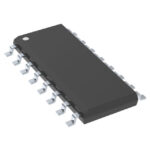 SN74HCS165QDYYRQ1
Understand load cell sensor output, bridge wiring and calibration. Learn how mV/V sensitivity, mechanics and ADC noise affect measurement accuracy.
Read More
Select power transformers by input frequency, secondary VA, rectifier load, isolation, regulation and inrush. Build a clearer specification for your next RFQ.
Read More
SN74HCS165QDYYRQ1 is listed in the Shift Registers range at ChipApex. The manufacturer field lists Texas Instruments. Its product description is AUTOMOTIVE 8-BIT PARALLEL-LOAD S.…
Read More
SN74HCS165QDYYRQ1 is listed in the Shift Registers range at ChipApex. The manufacturer field lists Texas Instruments. Its product description is AUTOMOTIVE 8-BIT PARALLEL-LOAD S.…
Read More
SN74HCS165QDYYRQ1 is listed in the Shift Registers range at ChipApex. The manufacturer field lists Texas Instruments. Its product description is AUTOMOTIVE 8-BIT PARALLEL-LOAD S.…
Read More
SN74HCS165QDYYRQ1 is listed in the Shift Registers range at ChipApex. The manufacturer field lists Texas Instruments. Its product description is AUTOMOTIVE 8-BIT PARALLEL-LOAD S.…
Read More
Learn how to use ferrite beads for noise filtering. Check impedance, DC bias, placement, resonance and load-step behavior before selecting a part.
Read More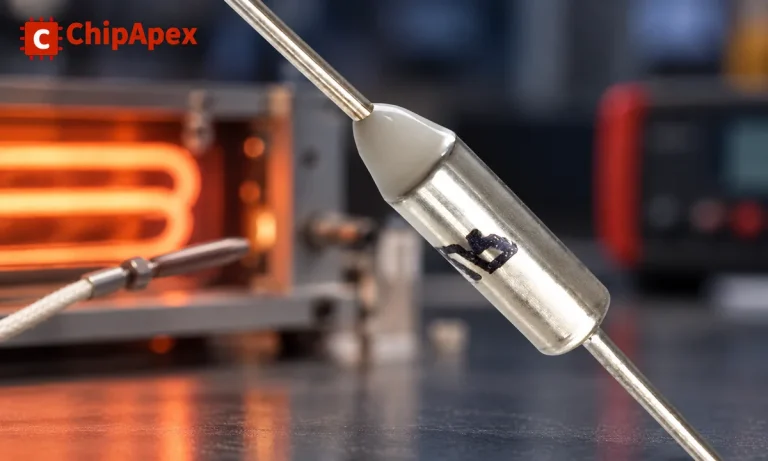
Understand thermal fuse operation, Tf, Th and Tm, electrical ratings and mounting. Check temperature limits and replacement requirements for your design.
Read More
SN74HCS165QDYYRQ1 is listed in the Shift Registers range at ChipApex. The manufacturer field lists Texas Instruments. Its product description is AUTOMOTIVE 8-BIT PARALLEL-LOAD S.…
Read More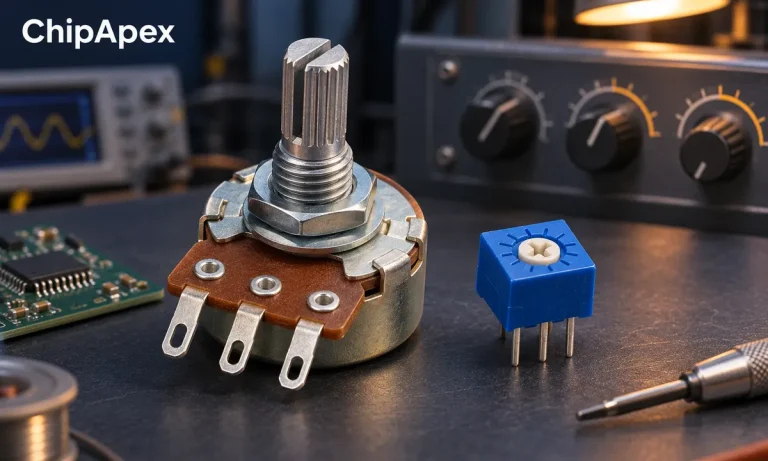
Compare rheostat and potentiometer wiring and functions. Understand divider loading, wiper current, track power and practical component selection.
Read More
Compare Pt100 and Pt1000 RTDs, two-, three- and four-wire connections, excitation and self-heating. Build an error budget from element to reported temperature.
Read More
SN74HCS165QDYYRQ1 is listed in the Shift Registers range at ChipApex. The manufacturer field lists Texas Instruments. Its product description is AUTOMOTIVE 8-BIT PARALLEL-LOAD S.…
Read More
The activity of extra discounts on wholesale prices is in full swing…
Please fill in your contact information and we will send you the latest wholesale price list.






