 ChipApex | Global Electronic Components Supplier

SEARCH
Search Product
Search Post
— IC芯片 | 连接器 | 传感器 | 被动器件 —
Search productSearch post
— IC芯片 | 连接器 | 传感器 | 被动器件 —
Consult the customer manager about the wholesale price.
consultation hotline:86-132-6715-2157
email:[email protected]
Contact the product manager for consultation. One-stop consultation is available.
Do you want a lower wholesale price? Please send us your inquiry and we will reply immediately.
SN74LS373NG4 is listed in the Latches range at ChipApex. The manufacturer field lists Texas Instruments. Its product description is IC D-TYPE TRANSP SGL 8:8 20DIP. Review the specifications below when checking this part for your BOM.
The SN74LS373NG4 is an octal transparent D-type latch manufactured by Texas Instruments, belonging to the SN74LS series. It features eight D-type latches with three-state outputs in a 20-pin PDIP package. The device operates within a supply voltage range of 4.75 V to 5.25 V and supports a propagation delay of 18 ns at 5 V. It provides a low-level output current of 32 mA and a high-level output current of -2.6 mA. The component functions as a bus driver with non-inverting polarity and is designed for through-hole mounting.
Verify the specific suffix 'G4' against official Texas Instruments documentation to confirm lead-free status and RoHS compliance details. Ensure the ordering part number matches the exact package type and temperature grade required for the design. Cross-reference with the latest datasheet revision to confirm pinout and electrical characteristics remain consistent with standard SN74LS373 specifications.
Select this component when an octal latch with three-state bus driving capability is required in a through-hole application. The LS logic family offers moderate speed suitable for general-purpose digital systems. Verify that the 5V supply voltage and operating temperature range align with the target environment constraints before finalizing the design integration.
This component is part of the SN74LS373 family of octal transparent latches. It serves as a fundamental building block for digital logic circuits requiring data retention and bus isolation. The device is widely used in microprocessor-based systems for interfacing between processors and peripheral devices or memory modules.
SN74LS373N
The Output Enable (OE) input controls the three-state nature of the outputs, allowing them to be placed in a high-impedance state.
When the Latch Enable (LE) input is high, the latch is transparent, meaning outputs follow inputs. When LE is low, the previous data level is latched.
Explore related parts through Logic, Integrated Circuits (ICs), all product categories, ChipApex homepage.
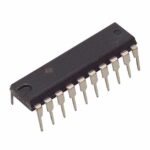 SN74LS373NG4

SN74LS373NG4 is listed in the Latches range at ChipApex. The manufacturer field lists Texas Instruments. Its product description is IC D-TYPE TRANSP SGL 8:8…
Read More
Learn how rectifiers convert AC to DC, compare half-wave and bridge circuits, and select voltage, current, recovery and thermal ratings for your design.
Read More
Understand how an electric energy meter measures power and accumulates kWh. Review sensing, phase alignment, calibration and metering IC selection.
Read More
SN74LS373NG4 is listed in the Latches range at ChipApex. The manufacturer field lists Texas Instruments. Its product description is IC D-TYPE TRANSP SGL 8:8…
Read More
SN74LS373NG4 is listed in the Latches range at ChipApex. The manufacturer field lists Texas Instruments. Its product description is IC D-TYPE TRANSP SGL 8:8…
Read More
SN74LS373NG4 is listed in the Latches range at ChipApex. The manufacturer field lists Texas Instruments. Its product description is IC D-TYPE TRANSP SGL 8:8…
Read More
SN74LS373NG4 is listed in the Latches range at ChipApex. The manufacturer field lists Texas Instruments. Its product description is IC D-TYPE TRANSP SGL 8:8…
Read More
Choose a solid-state relay by AC or DC load, leakage, switching mode and heat. Review practical SSR limits and prepare component requirements for ChipApex.
Read More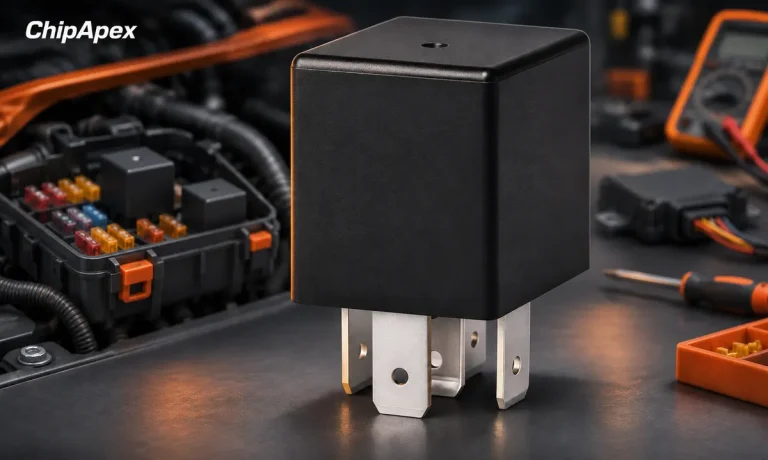
Understand automotive relay terminals, coil suppression and load ratings. Check inrush, socket compatibility and temperature before selecting a replacement.
Read More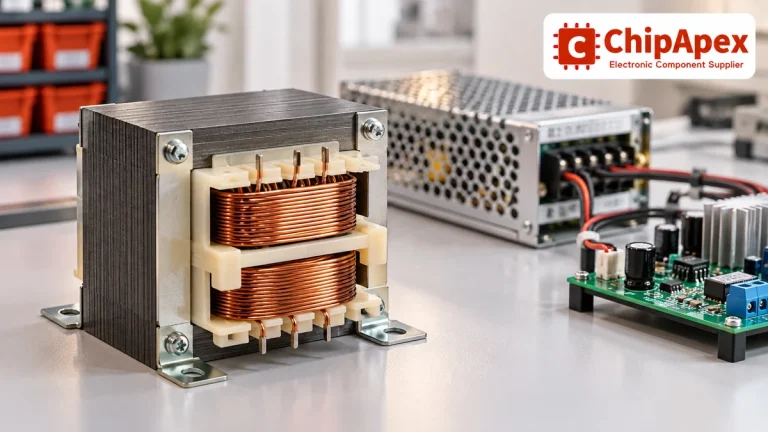
Select power transformers by input frequency, secondary VA, rectifier load, isolation, regulation and inrush. Build a clearer specification for your next RFQ.
Read More
Understand how a comparator switches at a voltage threshold, why hysteresis prevents chatter, and which output and input specs matter.
Read More
Learn why PTC resistance rises with temperature, how it differs from NTC, and which ratings matter for sensing and protection.
Read More
The activity of extra discounts on wholesale prices is in full swing…
Please fill in your contact information and we will send you the latest wholesale price list.






