 ChipApex | Global Electronic Components Supplier

SEARCH
Search Product
Search Post
— IC芯片 | 连接器 | 传感器 | 被动器件 —
Search productSearch post
— IC芯片 | 连接器 | 传感器 | 被动器件 —
Consult the customer manager about the wholesale price.
consultation hotline:86-132-6715-2157
email:[email protected]
Contact the product manager for consultation. One-stop consultation is available.
Do you want a lower wholesale price? Please send us your inquiry and we will reply immediately.
SN74LS379N is listed in the Flip Flops range at ChipApex. The manufacturer field lists Texas Instruments. Its product description is BIPOLAR GP LOGIC SCHOTTKY. Review the specifications below when checking this part for your BOM.
The SN74LS379N is a quad D-type flip-flop manufactured by Texas Instruments in the LS series. It features positive edge-triggered operation with complementary outputs and an enable function. The device operates within a temperature range of 0°C to +70°C. Key electrical parameters include a maximum clock frequency of 30MHz and a propagation delay of 17ns at 5V with a 15pF load. It utilizes a 16-pin dual in-line package (DIP) with terminals positioned on both sides.
Verify the specific package variant, as datasheets indicate availability in both DIP and SOIC formats. Confirm the manufacturer source, noting that some listings may represent New Old Stock from third-party distributors rather than current production units. Ensure the component matches the required pin configuration and voltage specifications for your circuit design before purchase.
Select this component for applications requiring quad D-type flip-flops with complementary outputs. Consider the 17ns propagation delay and 30MHz clock limit for timing constraints. Verify compatibility with existing logic families and ensure the 16-pin package fits the available board space. Check if the LS series power consumption meets system requirements compared to alternative logic families.
This part belongs to the Texas Instruments SN74LS series, which provides low-power Schottky logic functions. The SN74LS379 specifically addresses needs for multi-bit storage elements with enable control. It serves as a standard solution for digital systems requiring reliable data latching and buffering capabilities within the TTL logic family ecosystem.
Compatible substitutes include the SN74LS379DR in SOIC-16 packaging or generic equivalents like the MC74LS379P. Verify pinout compatibility and electrical characteristics match the original specifications before substitution.
Explore related parts through Logic, Integrated Circuits (ICs), all product categories, ChipApex homepage.
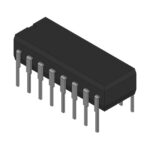 SN74LS379N
SN74LS379N is listed in the Flip Flops range at ChipApex. The manufacturer field lists Texas Instruments. Its product description is BIPOLAR GP LOGIC SCHOTTKY.…
Read More
Understand how oscillators generate timing signals, how they differ from crystals, and which frequency, output and stability specs matter when choosing one.
Read More
SN74LS379N is listed in the Flip Flops range at ChipApex. The manufacturer field lists Texas Instruments. Its product description is BIPOLAR GP LOGIC SCHOTTKY.…
Read More
SN74LS379N is listed in the Flip Flops range at ChipApex. The manufacturer field lists Texas Instruments. Its product description is BIPOLAR GP LOGIC SCHOTTKY.…
Read More
SN74LS379N is listed in the Flip Flops range at ChipApex. The manufacturer field lists Texas Instruments. Its product description is BIPOLAR GP LOGIC SCHOTTKY.…
Read More
SN74LS379N is listed in the Flip Flops range at ChipApex. The manufacturer field lists Texas Instruments. Its product description is BIPOLAR GP LOGIC SCHOTTKY.…
Read More
Learn how rectifiers convert AC to DC, compare half-wave and bridge circuits, and select voltage, current, recovery and thermal ratings for your design.
Read More
SN74LS379N is listed in the Flip Flops range at ChipApex. The manufacturer field lists Texas Instruments. Its product description is BIPOLAR GP LOGIC SCHOTTKY.…
Read More
SN74LS379N is listed in the Flip Flops range at ChipApex. The manufacturer field lists Texas Instruments. Its product description is BIPOLAR GP LOGIC SCHOTTKY.…
Read More
Understand tactile switches, PCB and keyboard differences, four-pin wiring, debounce, force, travel and replacement checks for reliable control inputs.
Read More
SN74LS379N is listed in the Flip Flops range at ChipApex. The manufacturer field lists Texas Instruments. Its product description is BIPOLAR GP LOGIC SCHOTTKY.…
Read More
See when an inductor behaves linearly, how DC bias and saturation reduce inductance, and which current and temperature curves to check.
Read More
The activity of extra discounts on wholesale prices is in full swing…
Please fill in your contact information and we will send you the latest wholesale price list.






