 ChipApex | Global Electronic Components Supplier

SEARCH
Search Product
Search Post
— IC芯片 | 连接器 | 传感器 | 被动器件 —
Search productSearch post
— IC芯片 | 连接器 | 传感器 | 被动器件 —
Consult the customer manager about the wholesale price.
consultation hotline:86-132-6715-2157
email:[email protected]
Contact the product manager for consultation. One-stop consultation is available.
Do you want a lower wholesale price? Please send us your inquiry and we will reply immediately.
SN74LVC573ANS is listed in the Latches range at ChipApex. The manufacturer field lists Texas Instruments. Its product description is IC D-TYPE TRANSP SGL 8:8 20SO. Review the specifications below when checking this part for your BOM.
The SN74LVC573ANS is an octal transparent D-type latch with 3-state outputs manufactured by Texas Instruments. It operates from a supply voltage of 1.65 V to 3.6 V and accepts input voltages up to 5.5 V. The device features a maximum propagation delay of 6.9 ns at 3.3 V and typical output ground bounce of 2 V. It provides high drive current capability, supporting loads up to 24 mA. The component is housed in a 20-pin NS (Small Outline Package) and supports mixed-mode signal operation.
Verify the specific package suffix 'NS' corresponds to the required Small Outline Package variant during procurement. Confirm that the operating temperature range meets system requirements, as the NS package typically supports -40°C to 85°C or -40°C to 125°C depending on the specific revision. Ensure ESD handling protocols are followed due to the MOS gate sensitivity described in the datasheet.
Select this component when designing bus interface applications requiring data retention or latching capabilities. It is suitable for driving highly capacitive or low-impedance loads due to its high drive strength. Consider the 5.5 V tolerant inputs if interfacing with higher voltage logic levels while maintaining a lower core supply voltage.
This part belongs to the SNx4LVC573A family of octal transparent D-type latches. The LVC series is designed for low-voltage CMOS applications. The 'SN74' prefix indicates commercial grade temperature ratings, distinguishing it from the military-grade SN54 series. The device integrates eight independent D-type latches with tri-state outputs into a single integrated circuit.
Direct replacements include SN74LVC573ADW, SN74LVC573APW, and SN74LVC573ADBR. Verify pinout compatibility and thermal characteristics when substituting packages such as SOIC, TSSOP, or SSOP variants.
Explore related parts through Logic, Integrated Circuits (ICs), all product categories, ChipApex homepage.
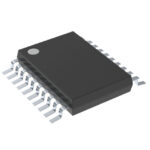 SN74LVC573ANS

Compare Pt100 and Pt1000 RTDs, two-, three- and four-wire connections, excitation and self-heating. Build an error budget from element to reported temperature.
Read More
SN74LVC573ANS is listed in the Latches range at ChipApex. The manufacturer field lists Texas Instruments. Its product description is IC D-TYPE TRANSP SGL 8:8…
Read More
SN74LVC573ANS is listed in the Latches range at ChipApex. The manufacturer field lists Texas Instruments. Its product description is IC D-TYPE TRANSP SGL 8:8…
Read More
SN74LVC573ANS is listed in the Latches range at ChipApex. The manufacturer field lists Texas Instruments. Its product description is IC D-TYPE TRANSP SGL 8:8…
Read More
Understand RF attenuator dB values, fixed and programmable types, impedance, power limits and noise tradeoffs before choosing parts for an RF signal path.
Read More
SN74LVC573ANS is listed in the Latches range at ChipApex. The manufacturer field lists Texas Instruments. Its product description is IC D-TYPE TRANSP SGL 8:8…
Read More
SN74LVC573ANS is listed in the Latches range at ChipApex. The manufacturer field lists Texas Instruments. Its product description is IC D-TYPE TRANSP SGL 8:8…
Read More
SN74LVC573ANS is listed in the Latches range at ChipApex. The manufacturer field lists Texas Instruments. Its product description is IC D-TYPE TRANSP SGL 8:8…
Read More
SN74LVC573ANS is listed in the Latches range at ChipApex. The manufacturer field lists Texas Instruments. Its product description is IC D-TYPE TRANSP SGL 8:8…
Read More
Learn what an IMU measures, how accelerometers and gyroscopes work together, why orientation estimates drift, and what to compare.
Read More
SN74LVC573ANS is listed in the Latches range at ChipApex. The manufacturer field lists Texas Instruments. Its product description is IC D-TYPE TRANSP SGL 8:8…
Read More
See when an inductor behaves linearly, how DC bias and saturation reduce inductance, and which current and temperature curves to check.
Read More
The activity of extra discounts on wholesale prices is in full swing…
Please fill in your contact information and we will send you the latest wholesale price list.





