 ChipApex | Global Electronic Components Supplier

SEARCH
Search Product
Search Post
— IC芯片 | 连接器 | 传感器 | 被动器件 —
Search productSearch post
— IC芯片 | 连接器 | 传感器 | 被动器件 —
Consult the customer manager about the wholesale price.
consultation hotline:86-132-6715-2157
email:[email protected]
Contact the product manager for consultation. One-stop consultation is available.
Do you want a lower wholesale price? Please send us your inquiry and we will reply immediately.
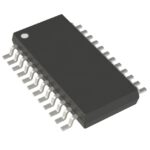
TRS207IDB is listed in the Drivers, Receivers, Transceivers range at ChipApex. The manufacturer field lists Texas Instruments. Its product description is IC TRANSCEIVER FULL 5/3 24SSOP. Review the specifications below when checking this part for your BOM.
The TRS207IDB is a 5-V multichannel RS-232 line driver/receiver manufactured by Texas Instruments. It integrates five line drivers, three line receivers, and a dual charge-pump circuit within an SSOP-24 package. The device operates at data signaling rates up to 120 kbit/s with a maximum driver output slew rate of 30 V/µs. It requires four external 0.1-µF capacitors for the charge pump and functions from a single 5-V supply (4.5 V to 5.5 V). The component provides ±15-kV ESD protection on RS-232 bus pins per the Human-Body Model and meets TIA/EIA-232-F standards.
Verify the specific ordering suffix 'DB' corresponds to the SSOP-24 tube packaging configuration. Confirm that the 'I' designation indicates the industrial temperature range of -40°C to +85°C. Ensure the procurement source provides the official datasheet SLLS809 for accurate pinout and electrical characteristic verification before integration into designs.
Select this component when a design requires five transmit channels and three receive channels in a compact SSOP-24 footprint. It is suitable for applications needing robust ESD protection on serial ports without requiring external voltage generation circuits. Verify that the system power supply remains stable between 4.5 V and 5.5 V to ensure compliance with the specified operating conditions.
The TRS207 belongs to the TRS207 family of 5-V multichannel RS-232 transceivers. The IDB suffix specifically denotes the industrial temperature grade (-40°C to +85°C) housed in a plastic SSOP-24 package. This variant is part of Texas Instruments' standard interface IC lineup designed for asynchronous communication controllers interfacing with serial-port connectors.
Publicly confirmed substitute part numbers are not available in the provided documentation.
Explore related parts through Interface, Integrated Circuits (ICs), all product categories, ChipApex homepage.
 TRS207IDB

Compare RC, crystal and MEMS oscillator circuits. Check ppm, jitter, load capacitance, startup margin and output compatibility before choosing a clock source.
Read More
TRS207IDB is listed in the Drivers, Receivers, Transceivers range at ChipApex. The manufacturer field lists Texas Instruments. Its product description is IC TRANSCEIVER FULL…
Read More
See how a MEMS gyroscope measures angular rate, why its angle estimate drifts, and which range, noise, interface and temperature specs to compare.
Read More
Learn the relay definition, coil and contact operation, NO and NC forms, load ratings and suppression choices. Compare mechanical, reed and solid-state types.
Read More
TRS207IDB is listed in the Drivers, Receivers, Transceivers range at ChipApex. The manufacturer field lists Texas Instruments. Its product description is IC TRANSCEIVER FULL…
Read More
Compare thermistors, RTDs, thermocouples and temperature ICs. Learn how range, accuracy, response, interfaces and mounting affect component selection.
Read More
TRS207IDB is listed in the Drivers, Receivers, Transceivers range at ChipApex. The manufacturer field lists Texas Instruments. Its product description is IC TRANSCEIVER FULL…
Read More
TRS207IDB is listed in the Drivers, Receivers, Transceivers range at ChipApex. The manufacturer field lists Texas Instruments. Its product description is IC TRANSCEIVER FULL…
Read More
TRS207IDB is listed in the Drivers, Receivers, Transceivers range at ChipApex. The manufacturer field lists Texas Instruments. Its product description is IC TRANSCEIVER FULL…
Read More
TRS207IDB is listed in the Drivers, Receivers, Transceivers range at ChipApex. The manufacturer field lists Texas Instruments. Its product description is IC TRANSCEIVER FULL…
Read More
Learn what an integrated circuit is, how ICs work, the main types and the specs to check before choosing a part for your design…
Read More
Learn why PTC resistance rises with temperature, how it differs from NTC, and which ratings matter for sensing and protection.
Read More
The activity of extra discounts on wholesale prices is in full swing…
Please fill in your contact information and we will send you the latest wholesale price list.







