 ChipApex | Global Electronic Components Supplier

SEARCH
Search Product
Search Post
— IC芯片 | 连接器 | 传感器 | 被动器件 —
Search productSearch post
— IC芯片 | 连接器 | 传感器 | 被动器件 —
Consult the customer manager about the wholesale price.
consultation hotline:86-132-6715-2157
email:[email protected]
Contact the product manager for consultation. One-stop consultation is available.
Do you want a lower wholesale price? Please send us your inquiry and we will reply immediately.
VBT2080C-M3/8W is listed in the Diode Arrays range at ChipApex. The manufacturer field lists Vishay General Semiconductor - Diodes Division. Its product description is DIODE ARR SCHOTT 80V 10A TO263AB. Review the specifications below when checking this part for your BOM.
The VBT2080C-M3/8W is a dual Trench MOS Barrier Schottky (TMBS) rectifier in a D2PAK (TO-263AB) package. It features a maximum repetitive peak reverse voltage of 80 V and a total maximum average forward rectified current of 20 A, with 10 A per diode. The device exhibits an ultra-low forward voltage drop of 0.52 V at 5 A and 0.60 V at 10 A. Peak forward surge current is rated at 100 A per diode. Operating junction temperature ranges from -55 °C to +150 °C.
Verify the specific ordering suffix '/8W' corresponds to the tape and reel delivery mode with a base quantity of 800 units. Confirm that the component meets RoHS compliance and halogen-free requirements as specified for the M3 series. Ensure thermal management aligns with the provided derating curves for the intended operating environment.
Select this component for designs requiring common cathode configurations with low conduction losses. The D2PAK package supports efficient heat dissipation via the exposed pad. Verify that the 80 V rating accommodates system voltage spikes and that the 10 A per diode limit suits the continuous load requirements without exceeding thermal resistance limits.
This part belongs to Vishay's Dual Trench MOS Barrier Schottky Rectifier family. It shares core TMBS technology with variants like the VFT2080C but utilizes a surface-mount D2PAK case instead of through-hole packages. The M3 suffix indicates lead-free construction compliant with modern environmental directives.
VBT2080C-E3/4W
The typical thermal resistance per diode is 3.0 °C/W.
Yes, it meets MSL level 1 per J-STD-020 with a maximum peak reflow temperature of 245 °C.
The maximum instantaneous forward voltage at 10 A is 0.70 V.
Explore related parts through Rectifiers, Diodes, Discrete Semiconductor Products, all product categories.
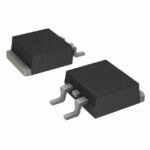 VBT2080C-M3/8W
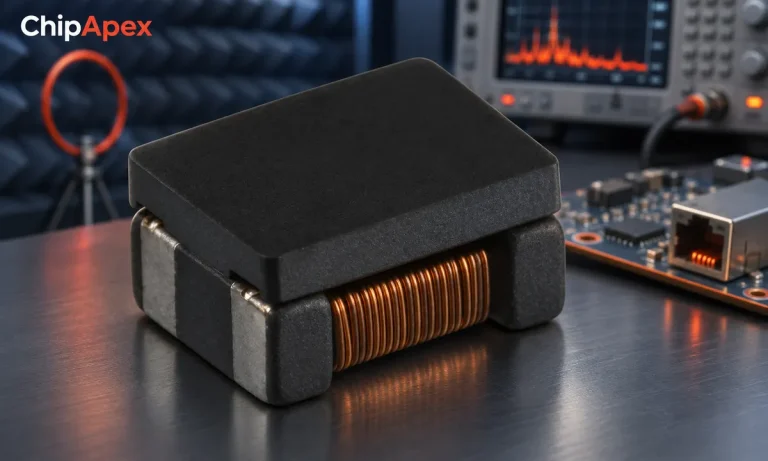
Select a common mode choke using noise frequency, current, insulation and signal integrity. Understand impedance curves, layout and filter limitations.
Read More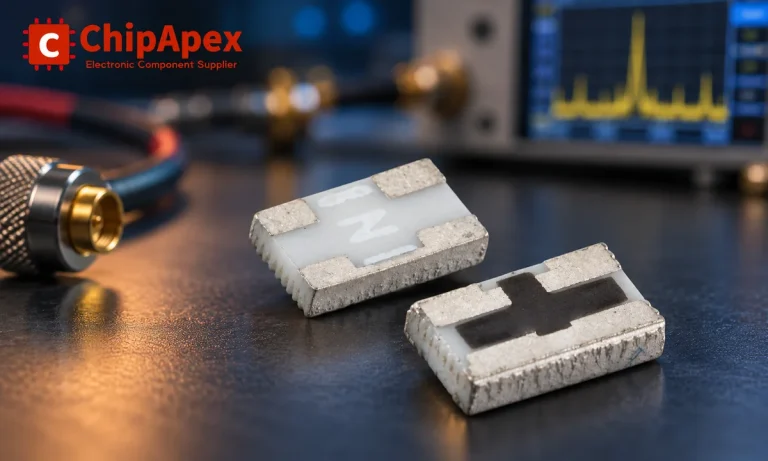
Understand RF attenuator dB values, fixed and programmable types, impedance, power limits and noise tradeoffs before choosing parts for an RF signal path.
Read More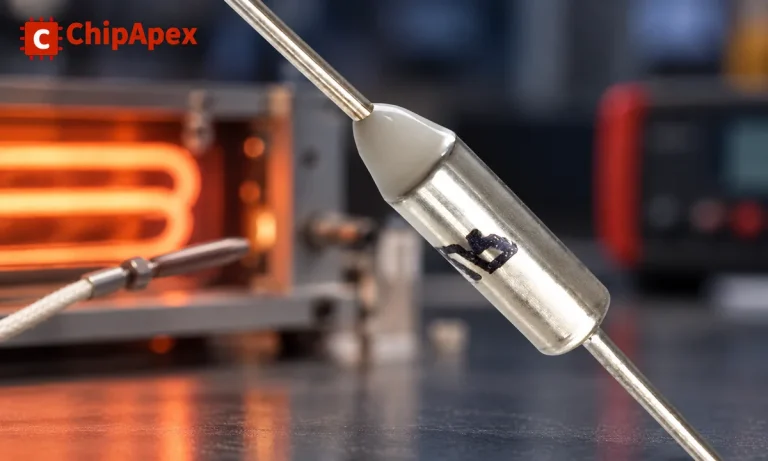
Understand thermal fuse operation, Tf, Th and Tm, electrical ratings and mounting. Check temperature limits and replacement requirements for your design.
Read More
Learn how a JFET works and how to compare bias, leakage, noise and pinout. Review practical selection questions for high-impedance analog circuits.
Read More
VBT2080C-M3/8W is listed in the Diode Arrays range at ChipApex. The manufacturer field lists Vishay General Semiconductor - Diodes Division. Its product description is…
Read More
Learn why PTC resistance rises with temperature, how it differs from NTC, and which ratings matter for sensing and protection.
Read More
Choose a rocker switch by AC/DC ratings, contact arrangement, illumination, panel fit and sealing. Get practical checks for engineering and component sourcing.
Read More
VBT2080C-M3/8W is listed in the Diode Arrays range at ChipApex. The manufacturer field lists Vishay General Semiconductor - Diodes Division. Its product description is…
Read More
VBT2080C-M3/8W is listed in the Diode Arrays range at ChipApex. The manufacturer field lists Vishay General Semiconductor - Diodes Division. Its product description is…
Read More
Learn the relay definition, coil and contact operation, NO and NC forms, load ratings and suppression choices. Compare mechanical, reed and solid-state types.
Read More
VBT2080C-M3/8W is listed in the Diode Arrays range at ChipApex. The manufacturer field lists Vishay General Semiconductor - Diodes Division. Its product description is…
Read More
Choose an AC to DC converter by input range, output demand, isolation, efficiency and thermal derating. Compare architectures and check installation needs.
Read More
The activity of extra discounts on wholesale prices is in full swing…
Please fill in your contact information and we will send you the latest wholesale price list.





