 ChipApex | Global Electronic Components Supplier

SEARCH
Search Product
Search Post
— IC芯片 | 连接器 | 传感器 | 被动器件 —
Search productSearch post
— IC芯片 | 连接器 | 传感器 | 被动器件 —
Consult the customer manager about the wholesale price.
consultation hotline:86-132-6715-2157
email:[email protected]
Contact the product manager for consultation. One-stop consultation is available.
Do you want a lower wholesale price? Please send us your inquiry and we will reply immediately.
The Schroff 20848640 is a rear panel designed for modular rack systems, featuring a height of 6 HE (132 mm) and a width accommodating 28 TE (141.9 mm). Constructed from aluminum, this component provides structural support and mounting points for electronic equipment within enclosures. The panel includes specific divider units to organize internal space and maintains a depth of 2.5 mm relative to the mounting interface. It serves as a critical finishing element for rack assemblies, ensuring proper alignment and stability for installed modules.
Verify part number accuracy against official nVent Schroff documentation before procurement. Confirm mechanical dimensions and mounting hole patterns match existing rack infrastructure. Ensure material specifications align with environmental requirements. Check for any specific ordering suffixes that may indicate variations in finish or accessory inclusion. Validate supplier authorization status to guarantee genuine components.
Select this rear panel when a 6 HE by 28 TE footprint is required for rack termination. Consider aluminum construction for standard industrial environments. Evaluate compatibility with adjacent Schroff series components to ensure seamless integration. Verify that the 2.5 mm depth specification meets spatial constraints within the enclosure design. Assess whether the included divider units satisfy organizational needs without additional modifications.
This component belongs to the nVent Schroff range of combinable and modular electronic packaging solutions. The brand specializes in electronics cabinets, laboratory racks, and ruggedized enclosures. The 20848640 model functions as a standardized accessory within this ecosystem, supporting scalable system architectures. It complements other Schroff products by providing essential structural closure and mounting capabilities for professional rack installations.
Publicly confirmed substitute part numbers are not available in the provided documentation. Users should consult official nVent Schroff catalogs for equivalent models with compatible dimensions. Verify that any alternative rear panel matches the 6 HE height and 28 TE width specifications exactly.
 20848640

Understand RF attenuator dB values, fixed and programmable types, impedance, power limits and noise tradeoffs before choosing parts for an RF signal path.
Read More
PLANO, Texas – March 20, 2026 – Diodes Incorporated (Nasdaq: DIOD), a leading global manufacturer and supplier of high-quality application-specific standard products in the…
Read More
Compare thermistors, RTDs, thermocouples and temperature ICs. Learn how range, accuracy, response, interfaces and mounting affect component selection.
Read More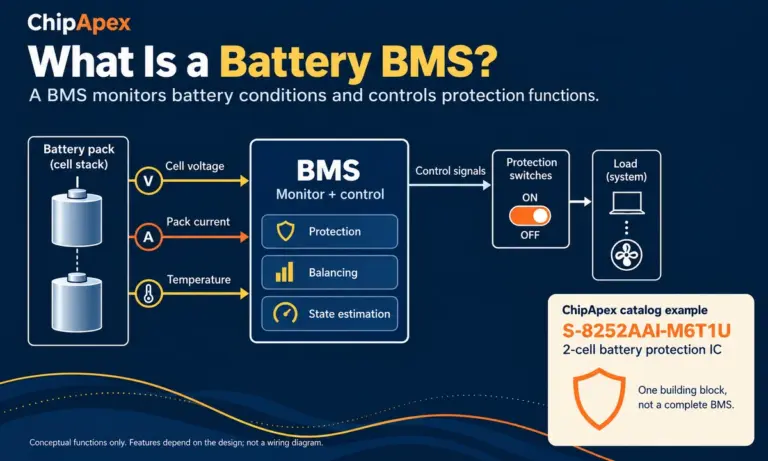
Learn what a battery BMS does, how protection differs from charging, and which pack specifications to check when sourcing BMS components through ChipApex.
Read More
Dutch authorities announced on November 7 the lifting of control measures on Nexperia (formerly NXP Semiconductors’ Standard Products division), marking the end of a…
Read More
Learn how a diode conducts, how to identify anode and cathode, and when to choose rectifier, TVS, Zener or photodiode types for a circuit.
Read More
On September 22nd, it was reported that Samsung Electronics, the South Korean tech giant, had successfully passed NVIDIA’s certification test for its 12-layer HBM3E…
Read More
A perfect storm of surging demand and supply chain disruptions is roiling the global electronic components market, with advanced semiconductors and critical materials now…
Read More
May 4, 2026 — The global power semiconductor market is grappling with a worsening supply crunch, as lead times for key components have extended…
Read More
Recently, a survey by the Electronic Components Industry Association (ECIA) revealed that the sales sentiment of global electronic components remained optimistic in the third…
Read More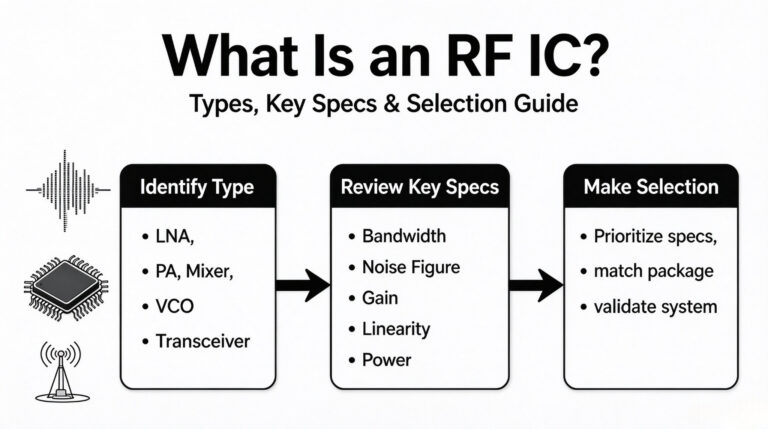
An RF IC, or radio-frequency integrated circuit, is a chip that processes wireless signals between the antenna and the baseband processor. Instead of building…
Read More
If you’ve spent any time staring at a schematic, you’ve seen the triangle. Two inputs, one output, and a gain symbol that looks deceptively…
Read More
The activity of extra discounts on wholesale prices is in full swing…
Please fill in your contact information and we will send you the latest wholesale price list.




