 ChipApex | Global Electronic Components Supplier

SEARCH
Search Product
Search Post
— IC芯片 | 连接器 | 传感器 | 被动器件 —
Search productSearch post
— IC芯片 | 连接器 | 传感器 | 被动器件 —
Consult the customer manager about the wholesale price.
consultation hotline:86-132-6715-2157
email:[email protected]
Contact the product manager for consultation. One-stop consultation is available.
Do you want a lower wholesale price? Please send us your inquiry and we will reply immediately.
The King Innovation 67215-KNGI is an orange, three-port push-in wire connector from the Contractors' Choice series. It accommodates 22 to 12 AWG solid or stranded copper wires. The device features a polycarbonate housing with flame retardant properties and includes integrally designed test ports for convenient circuit verification. It provides color-coded port identification to streamline connections. The unit is rated for a maximum voltage of 600V for building wires and supports temperatures up to 105°C (221°F). It holds UL and CSA approvals for use in Canada and the United States.
Verify that the specific part number 67215-KNGI matches the required three-port configuration and orange color coding. Confirm compatibility with 22-12 AWG copper conductors. Ensure the application environment does not exceed the 105°C temperature rating. Check for UL and CSA certification marks on packaging to guarantee compliance with regional electrical codes. Avoid using this component for aluminum wires unless explicitly specified by updated manufacturer guidelines.
Select this model when a reliable, tool-free connection method is required for standard copper wiring. The three-port design allows joining three wires simultaneously, reducing assembly time compared to two-port alternatives. The integrated test ports offer a distinct advantage over standard connectors by facilitating live circuit checks. Choose this variant for indoor applications where flame retardant materials are mandated. Consider the orange color for visual differentiation in complex wiring panels.
This component belongs to the King Innovation 672 Series terminals, specifically the Contractors' Choice line. It is designed as an indoor wire connector for general electrical purposes. The series emphasizes ease of use through push-in technology and safety features like flame retardancy. It serves as a direct replacement for traditional twist-on wire nuts in many standard building wire applications.
Direct substitutes include other King Innovation three-port push-in connectors within the same series, such as the 67205-KNGI if a two-port configuration is acceptable. Verify that any replacement maintains the 600V rating and 105°C temperature limit. Ensure the substitute also offers UL/CSA approval for the intended market.
 67215-KNGI
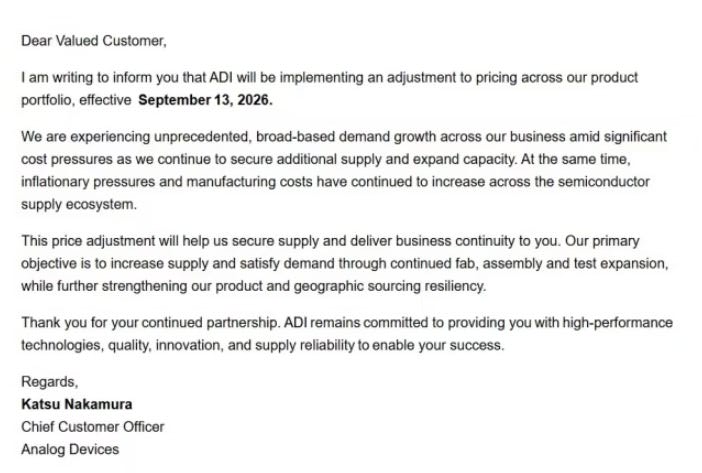
WILMINGTON, Mass. – August 11, 2026 — Analog Devices, Inc. (NASDAQ: ADI), the global leading supplier of high-performance analog, mixed-signal and digital signal processing…
Read More
On September 22nd, it was reported that Samsung Electronics, the South Korean tech giant, had successfully passed NVIDIA’s certification test for its 12-layer HBM3E…
Read More
Learn what a battery BMS does, how protection differs from charging, and which pack specifications to check when sourcing BMS components through ChipApex.
Read More
Every audio power amplifier design starts with the same fundamental challenge: converting a low-voltage line-level signal into the high-current drive required by a reactive…
Read More
See how a MEMS gyroscope measures angular rate, why its angle estimate drifts, and which range, noise, interface and temperature specs to compare.
Read More
See when an inductor behaves linearly, how DC bias and saturation reduce inductance, and which current and temperature curves to check.
Read More
Learn what an integrated circuit is, how ICs work, the main types and the specs to check before choosing a part for your design…
Read More
On October 1, 2025 local time, OpenAI, an artificial intelligence research company, announced the establishment of a cooperative relationship with Samsung Electronics and SK…
Read More
Recently, global semiconductor manufacturers have been constantly making moves in aspects such as technological cooperation, product manufacturing processes, and market layout, demonstrating the rapid…
Read More
Compare Pt100 and Pt1000 RTDs, two-, three- and four-wire connections, excitation and self-heating. Build an error budget from element to reported temperature.
Read More
Learn how rectifiers convert AC to DC, compare half-wave and bridge circuits, and select voltage, current, recovery and thermal ratings for your design.
Read More
Compare thermistors, RTDs, thermocouples and temperature ICs. Learn how range, accuracy, response, interfaces and mounting affect component selection.
Read More
The activity of extra discounts on wholesale prices is in full swing…
Please fill in your contact information and we will send you the latest wholesale price list.




