ChipApex | Global Electronic Components Supplier

SEARCH
Search Product
Search Post
— IC芯片 | 连接器 | 传感器 | 被动器件 —
Search productSearch post
— IC芯片 | 连接器 | 传感器 | 被动器件 —
Consult the customer manager about the wholesale price.
consultation hotline:86-132-6715-2157
email:[email protected]
Contact the product manager for consultation. One-stop consultation is available.
Do you want a lower wholesale price? Please send us your inquiry and we will reply immediately.
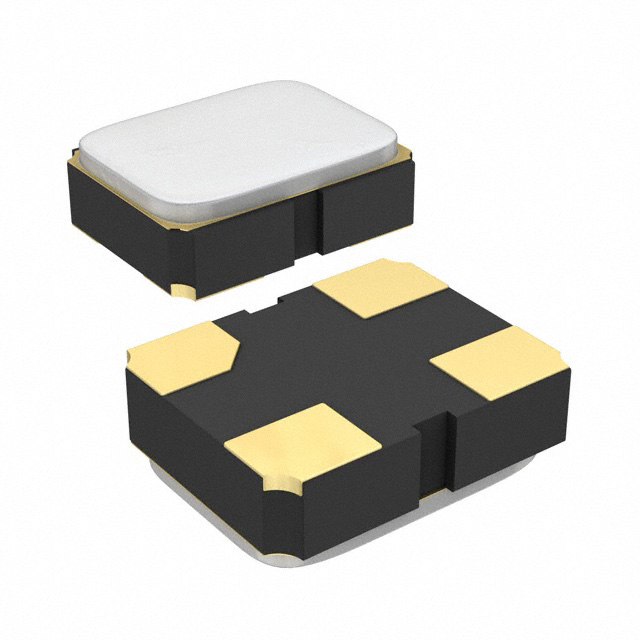
8NE-20.000MCJ-T is listed in the Oscillators range at ChipApex. The manufacturer field lists TXC CORPORATION. Its product description is XTAL OSC XO 20.000MHZ CMOS SMD. Review the specifications below when checking this part for your BOM.
The 8NE-20.000MCJ-T is a standard clock oscillator manufactured by TXC Corporation, designed for low electromagnetic interference applications. It operates at a nominal frequency of 20 MHz with a stability of ±50 ppm. The device utilizes CMOS output format and requires a supply voltage ranging from 2.375 V to 2.625 V. It features an enable/disable control function and draws a maximum current of 10 mA. The component is housed in a compact 4-SMD, no-lead package measuring 2 mm x 1.6 mm x 0.76 mm. It supports surface mount technology and functions within an operating temperature range of -40°C to +105°C.
Verify the specific suffix MCJ against official datasheets to confirm voltage and package compatibility. Ensure the supplier provides valid RoHS compliance documentation. Confirm the enable/disable feature is supported by your circuit design. Check for AEC-Q200 certification if automotive grade is required. Validate the operating temperature range meets your environmental specifications.
Select this component when a small form factor and low noise are critical. The 2.5V supply requirement suits low-power digital logic. Consider the ±50 ppm stability for general clocking needs. The wide temperature range allows use in harsh environments. Verify pinout compatibility with existing PCB footprints before integration.
This part belongs to the 8NE series of quartz oscillators from TXC Corporation. The series focuses on miniaturization and low electromagnetic interference performance. It serves as a direct replacement for larger crystal resonators in space-constrained designs. The CMOS output ensures compatibility with standard digital interfaces.
Check for exact frequency and voltage match. Verify package dimensions for physical fit. Confirm output drive strength and load capacitance requirements.
Explore related parts through Crystals, Oscillators, Resonators, all product categories, ChipApex homepage.
 8NE-20.000MCJ-T

8NE-20.000MCJ-T is listed in the Oscillators range at ChipApex. The manufacturer field lists TXC CORPORATION. Its product description is XTAL OSC XO 20.000MHZ CMOS…
Read More
Understand how a comparator switches at a voltage threshold, why hysteresis prevents chatter, and which output and input specs matter.
Read More
8NE-20.000MCJ-T is listed in the Oscillators range at ChipApex. The manufacturer field lists TXC CORPORATION. Its product description is XTAL OSC XO 20.000MHZ CMOS…
Read More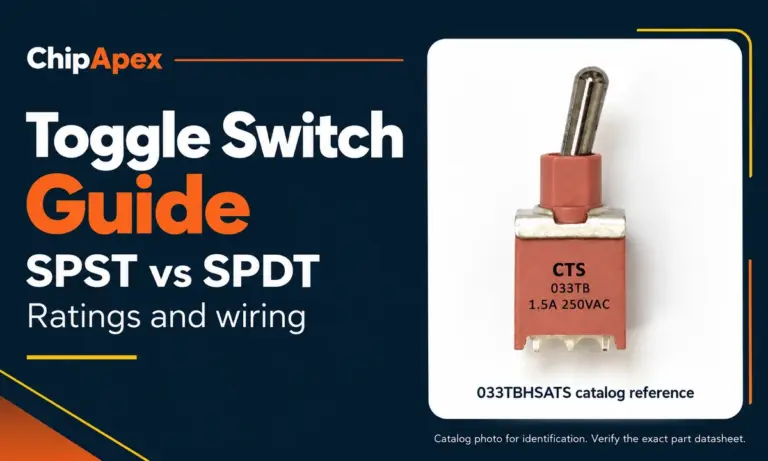
Compare SPST and SPDT toggle switches, understand AC/DC ratings, and follow wiring examples. Check contact action, mounting and parts in the ChipApex catalog.
Read More
Learn the relay definition, coil and contact operation, NO and NC forms, load ratings and suppression choices. Compare mechanical, reed and solid-state types.
Read More
8NE-20.000MCJ-T is listed in the Oscillators range at ChipApex. The manufacturer field lists TXC CORPORATION. Its product description is XTAL OSC XO 20.000MHZ CMOS…
Read More
8NE-20.000MCJ-T is listed in the Oscillators range at ChipApex. The manufacturer field lists TXC CORPORATION. Its product description is XTAL OSC XO 20.000MHZ CMOS…
Read More
See how a MEMS gyroscope measures angular rate, why its angle estimate drifts, and which range, noise, interface and temperature specs to compare.
Read More
Find out when a bare shock switch needs a pull resistor, when an MCU internal pull-up is enough, and why sensor modules and piezo…
Read More
Compare RC, crystal and MEMS oscillator circuits. Check ppm, jitter, load capacitance, startup margin and output compatibility before choosing a clock source.
Read More
8NE-20.000MCJ-T is listed in the Oscillators range at ChipApex. The manufacturer field lists TXC CORPORATION. Its product description is XTAL OSC XO 20.000MHZ CMOS…
Read More
Learn what an IMU measures, how accelerometers and gyroscopes work together, why orientation estimates drift, and what to compare.
Read More
The activity of extra discounts on wholesale prices is in full swing…
Please fill in your contact information and we will send you the latest wholesale price list.