ChipApex | Global Electronic Components Supplier

SEARCH
Search Product
Search Post
— IC芯片 | 连接器 | 传感器 | 被动器件 —
Search productSearch post
— IC芯片 | 连接器 | 传感器 | 被动器件 —
Consult the customer manager about the wholesale price.
consultation hotline:86-132-6715-2157
email:[email protected]
Contact the product manager for consultation. One-stop consultation is available.
Do you want a lower wholesale price? Please send us your inquiry and we will reply immediately.
ADS8383IPFBT is listed in the Analog To Digital Converters (ADC) range at ChipApex. The manufacturer field lists Texas Instruments. Its product description is IC ADC 18BIT SAR 48TQFP. Review the specifications below when checking this part for your BOM.
The ADS8383IPFBT is an 18-bit, 500-kSPS successive approximation register (SAR) analog-to-digital converter manufactured by Texas Instruments. It features a unipolar input range and includes an onboard reference buffer. The device supports flexible data transfer via an 8-, 16-, or 18-bit parallel interface. Powered by a 5-V analog supply (+VA) and a 2.95-V to 5.25-V digital supply (+VBD), it dissipates approximately 110 mW at maximum throughput. The component is housed in a 48-lead TQFP package and operates within an industrial temperature range of −40°C to 85°C.
Verify the specific suffix against the manufacturer's Package Option Addendum to confirm the exact transport media and quantity. The IPFBT designation indicates a tape and reel configuration. Confirm that the ordering information matches current availability on the official Texas Instruments website, as manufacturing status can change without immediate notification.
Select the ADS8383I variant if 17-bit performance is sufficient, or the ADS8383IB variant for full 18-bit integral linearity specifications. Ensure the application requires a unipolar input voltage range compatible with the reference voltage. Verify that the host system can accommodate the required 48-pin TQFP footprint and the necessary parallel control signals such as CONVST, CS, and RD.
This component belongs to the ADS838x family of high-resolution, high-speed ADCs from Texas Instruments. It utilizes a charge redistribution SAR architecture with inherent sample-and-hold capabilities. The device is designed for applications requiring precise data acquisition with minimal processing delay, distinguishing it from lower-resolution or serial-interface alternatives in the broader portfolio.
Publicly confirmed substitute part numbers are not available in the provided documentation.
Explore related parts through Data Acquisition, Integrated Circuits (ICs), all product categories, ChipApex homepage.
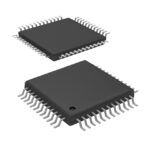 ADS8383IPFBT

Understand tactile switches, PCB and keyboard differences, four-pin wiring, debounce, force, travel and replacement checks for reliable control inputs.
Read More
Learn how rectifiers convert AC to DC, compare half-wave and bridge circuits, and select voltage, current, recovery and thermal ratings for your design.
Read More
ADS8383IPFBT is listed in the Analog To Digital Converters (ADC) range at ChipApex. The manufacturer field lists Texas Instruments. Its product description is IC…
Read More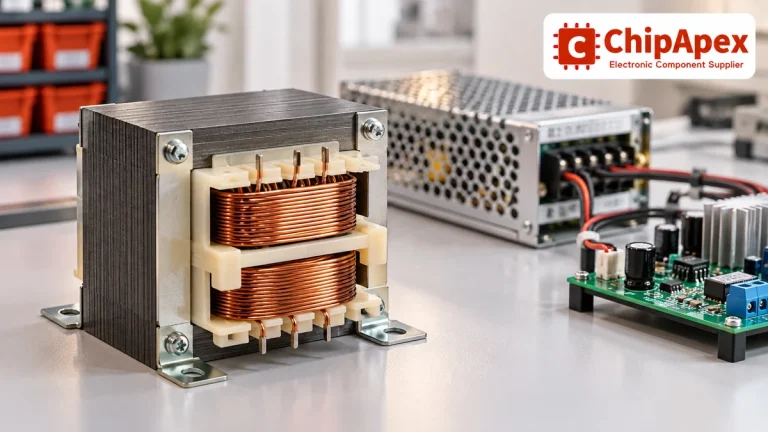
Select power transformers by input frequency, secondary VA, rectifier load, isolation, regulation and inrush. Build a clearer specification for your next RFQ.
Read More
ADS8383IPFBT is listed in the Analog To Digital Converters (ADC) range at ChipApex. The manufacturer field lists Texas Instruments. Its product description is IC…
Read More
Understand how a comparator switches at a voltage threshold, why hysteresis prevents chatter, and which output and input specs matter.
Read More
ADS8383IPFBT is listed in the Analog To Digital Converters (ADC) range at ChipApex. The manufacturer field lists Texas Instruments. Its product description is IC…
Read More
ADS8383IPFBT is listed in the Analog To Digital Converters (ADC) range at ChipApex. The manufacturer field lists Texas Instruments. Its product description is IC…
Read MoreADS8383IPFBT is listed in the Analog To Digital Converters (ADC) range at ChipApex. The manufacturer field lists Texas Instruments. Its product description is IC…
Read More
ADS8383IPFBT is listed in the Analog To Digital Converters (ADC) range at ChipApex. The manufacturer field lists Texas Instruments. Its product description is IC…
Read More
ADS8383IPFBT is listed in the Analog To Digital Converters (ADC) range at ChipApex. The manufacturer field lists Texas Instruments. Its product description is IC…
Read More
Understand how oscillators generate timing signals, how they differ from crystals, and which frequency, output and stability specs matter when choosing one.
Read More
The activity of extra discounts on wholesale prices is in full swing…
Please fill in your contact information and we will send you the latest wholesale price list.