 ChipApex | Global Electronic Components Supplier

SEARCH
Search Product
Search Post
— IC芯片 | 连接器 | 传感器 | 被动器件 —
Search productSearch post
— IC芯片 | 连接器 | 传感器 | 被动器件 —
Consult the customer manager about the wholesale price.
consultation hotline:86-132-6715-2157
email:[email protected]
Contact the product manager for consultation. One-stop consultation is available.
Do you want a lower wholesale price? Please send us your inquiry and we will reply immediately.
The Hoffman AT121224 is an angled wiring trough designed for NEMA Type 1 environments. Constructed from mild steel with a gray finish, it measures 12 inches in width, 12 inches in depth, and 24 inches in height. The unit accommodates conduit sizes up to 3 inches and utilizes two cover screws for secure closure. This component facilitates flexible wire routing through six sides of an enclosure, eliminating the need for costly 90-degree conduit bends.
Verify that the required NEMA Type 1 rating aligns with environmental exposure conditions. Confirm that the 12x12x24 inch dimensions fit within the designated enclosure space. Ensure compatibility with existing conduit sizes up to 3 inches. Check that the mild steel construction and gray finish meet aesthetic and corrosion resistance requirements for the specific application site.
Select this model when significant reduction in installation labor is prioritized over standard straight trough designs. It is suitable for applications where wires must enter or exit from multiple angles without complex bending. Consider the NEMA Type 1 rating for indoor use only. Evaluate the 12-inch by 12-inch cross-section against maximum cable bundle diameter requirements.
This angled trough belongs to the Hoffman Angled Trough Series, which focuses on streamlining wire pulling processes. It serves as an alternative to traditional rectangular troughs that require rigid conduit bending. The series aims to optimize material usage and labor costs in electrical panel manufacturing and maintenance scenarios.
No public confirmed substitute part numbers are available.
 AT121224

Compare thermistors, RTDs, thermocouples and temperature ICs. Learn how range, accuracy, response, interfaces and mounting affect component selection.
Read MoreA digital-to-analog converter (DAC) turns a digital number into an analog voltage or current. It lets a controller set a physical output, such as…
Read More
Understand voltage controlled oscillator tuning, phase noise and PLL operation. Check supply noise, output loading and requirements before selection.
Read More
Compare RC, crystal and MEMS oscillator circuits. Check ppm, jitter, load capacitance, startup margin and output compatibility before choosing a clock source.
Read More
Choose logic inverter ICs by thresholds, supply, output drive and delay. Compare standard and Schmitt-trigger inputs, power sequencing and replacement checks.
Read More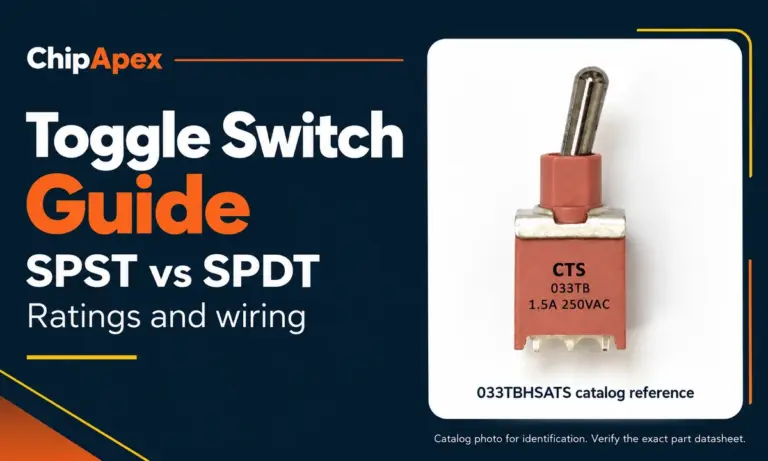
Compare SPST and SPDT toggle switches, understand AC/DC ratings, and follow wiring examples. Check contact action, mounting and parts in the ChipApex catalog.
Read More
Choose LED drivers by current, string voltage, dimming and thermal limits. Understand constant-current operation and the checks needed for your load.
Read More
Learn what an integrated circuit is, how ICs work, the main types and the specs to check before choosing a part for your design…
Read More
Understand how a comparator switches at a voltage threshold, why hysteresis prevents chatter, and which output and input specs matter.
Read More
Wilmington, Mass. & Milpitas, Calif. – May 19, 2026 – Analog Devices, Inc. (NASDAQ: ADI), a global leader in high-performance analog and mixed-signal semiconductors,…
Read More
Understand RF attenuator dB values, fixed and programmable types, impedance, power limits and noise tradeoffs before choosing parts for an RF signal path.
Read More
Compare gas sensor technologies, cross-sensitivity and calibration needs. Define the gas, range and environment before choosing a sensing component.
Read More
The activity of extra discounts on wholesale prices is in full swing…
Please fill in your contact information and we will send you the latest wholesale price list.




