ChipApex | Global Electronic Components Supplier

SEARCH
Search Product
Search Post
— IC芯片 | 连接器 | 传感器 | 被动器件 —
Search productSearch post
— IC芯片 | 连接器 | 传感器 | 被动器件 —
Consult the customer manager about the wholesale price.
consultation hotline:86-132-6715-2157
email:[email protected]
Contact the product manager for consultation. One-stop consultation is available.
Do you want a lower wholesale price? Please send us your inquiry and we will reply immediately.
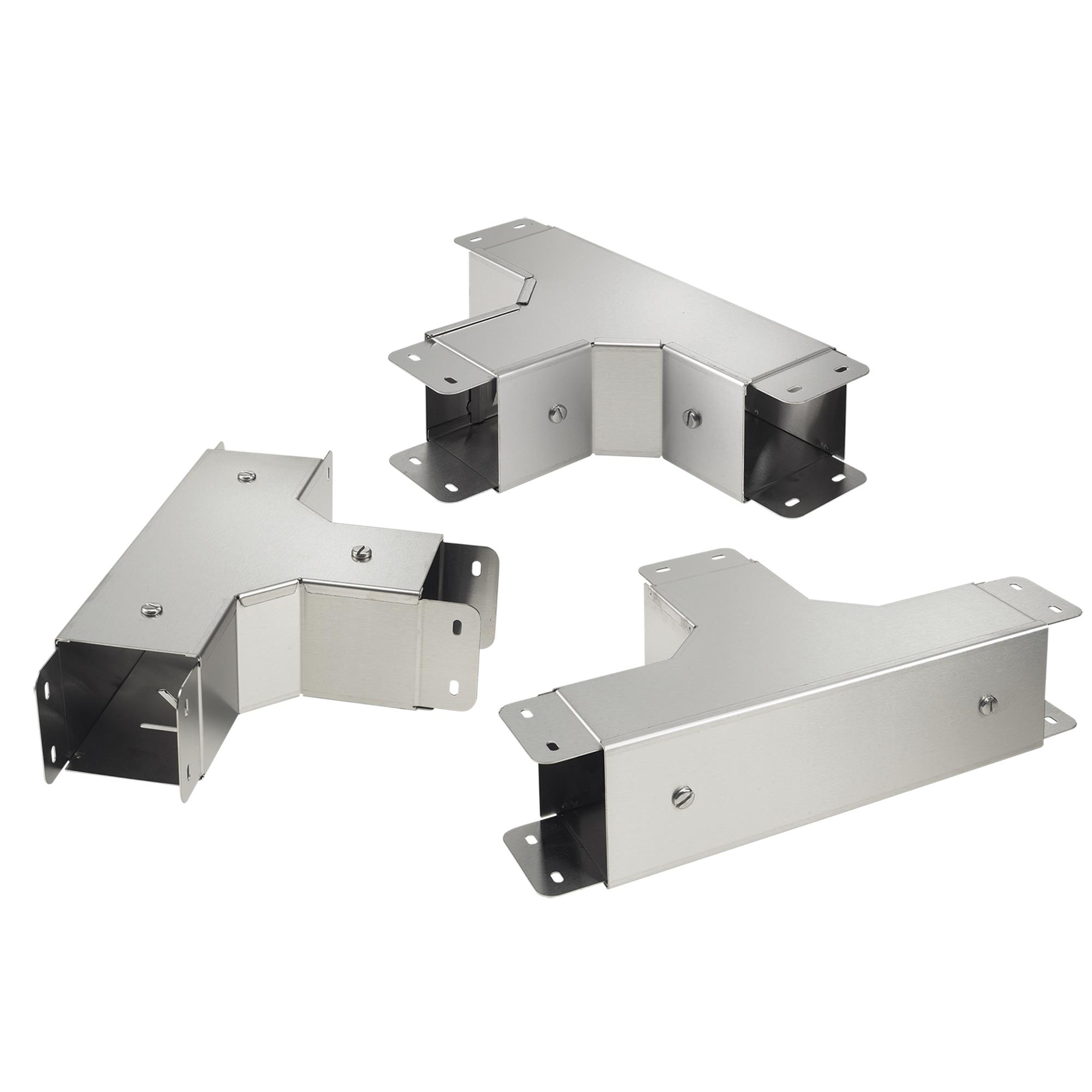
The CTS33PTFCSS is a Clean Tray® accessory manufactured by Hoffman Enclosures, Inc. It functions as a 90-degree tray tee connector designed for cable management systems. Constructed from 304 stainless steel, the component features a sloped perforated front cover to facilitate airflow and debris shedding. The unit accommodates a 3-inch wide tray configuration with a height of 7 inches. This part enables directional changes in tray routing while maintaining structural integrity and environmental resistance suitable for industrial applications.
Verify the specific material grade and dimensional tolerances against project requirements before ordering. Confirm that the 304 stainless steel specification meets the environmental exposure criteria of the installation site. Ensure compatibility with existing 3-inch wide tray infrastructure. Check for any regional compliance certifications required for the intended deployment location.
Select this component when a durable, corrosion-resistant 90-degree junction is required within a stainless steel cable tray network. The sloped perforated cover aids in maintenance and ventilation. Consider the 7-inch height constraint relative to surrounding equipment. Evaluate the need for 304 stainless steel versus other grades based on chemical exposure levels in the operating environment.
This item belongs to the Hoffman Clean Tray® series, which provides specialized accessories for organized cable management. The CTS33PTFCSS specifically addresses the need for directional transitions in rigid tray systems. It complements straight runs and other fittings to create complete routing solutions. The product line emphasizes durability and ease of installation in demanding industrial settings.
No public confirmed substitute part numbers are available in the provided documentation.
 CTS33PTFCSS
Choose a rocker switch by AC/DC ratings, contact arrangement, illumination, panel fit and sealing. Get practical checks for engineering and component sourcing.
Read More
Understand load cell sensor output, bridge wiring and calibration. Learn how mV/V sensitivity, mechanics and ADC noise affect measurement accuracy.
Read More
Learn how a diode conducts, how to identify anode and cathode, and when to choose rectifier, TVS, Zener or photodiode types for a circuit.
Read More
Recently, a survey by the Electronic Components Industry Association (ECIA) revealed that the sales sentiment of global electronic components remained optimistic in the third…
Read More
Learn what data acquisition means, from sensors and conditioning to sampling and storage. Review channel timing, wiring, calibration and data quality.
Read MoreA digital-to-analog converter (DAC) turns a digital number into an analog voltage or current. It lets a controller set a physical output, such as…
Read More
Learn how a pressure transducer converts pressure into voltage, current, or digital output, and compare pressure references and key selection specs.
Read More
Understand RF attenuator dB values, fixed and programmable types, impedance, power limits and noise tradeoffs before choosing parts for an RF signal path.
Read More
May 4, 2026 — The global power semiconductor market is grappling with a worsening supply crunch, as lead times for key components have extended…
Read More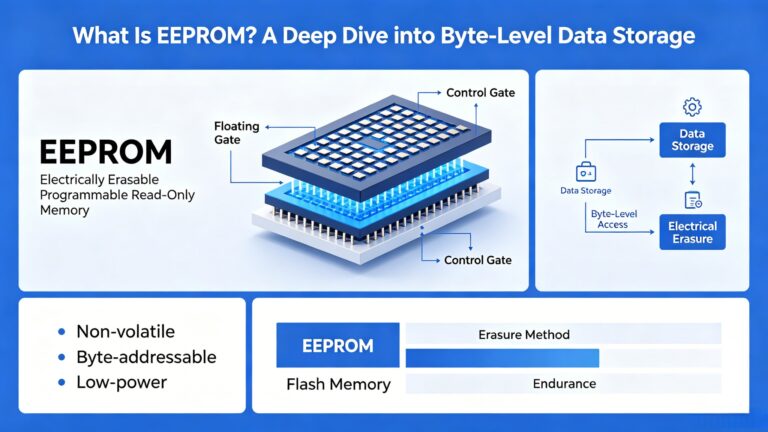
In the vast landscape of memory technology, EEPROM (Electrically Erasable Programmable Read-Only Memory) often plays the unsung hero. While NAND Flash grabs headlines for…
Read More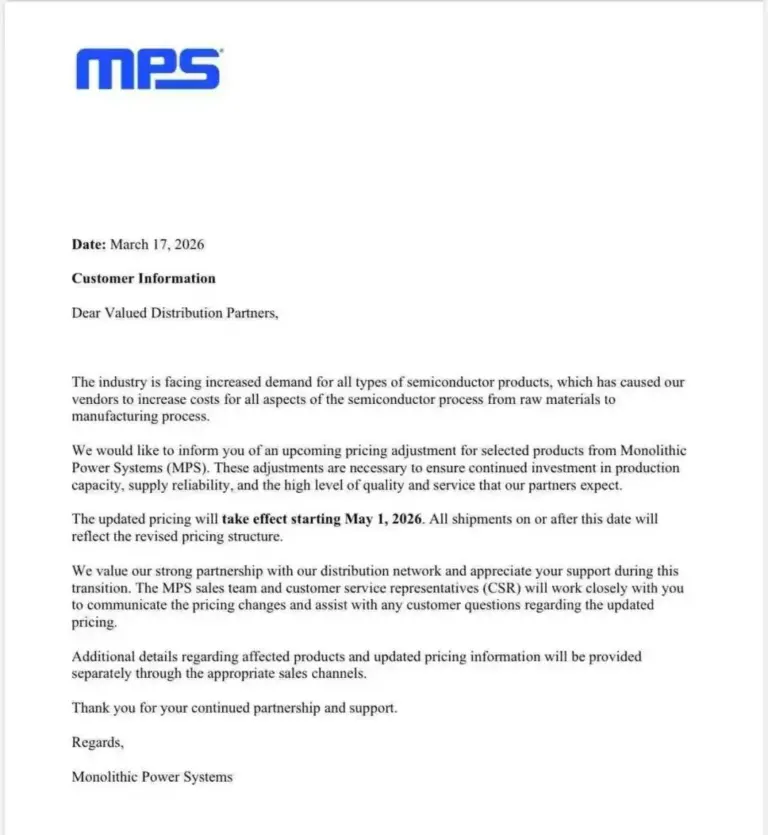
Monolithic Power Systems (MPS), a global leader in analog and mixed-signal semiconductors, has notified its distribution partners of an upcoming price increase for selected…
Read More
If you’ve spent any time staring at a schematic, you’ve seen the triangle. Two inputs, one output, and a gain symbol that looks deceptively…
Read More
The activity of extra discounts on wholesale prices is in full swing…
Please fill in your contact information and we will send you the latest wholesale price list.