 ChipApex | Global Electronic Components Supplier

SEARCH
Search Product
Search Post
— IC芯片 | 连接器 | 传感器 | 被动器件 —
Search productSearch post
— IC芯片 | 连接器 | 传感器 | 被动器件 —
Consult the customer manager about the wholesale price.
consultation hotline:86-132-6715-2157
email:[email protected]
Contact the product manager for consultation. One-stop consultation is available.
Do you want a lower wholesale price? Please send us your inquiry and we will reply immediately.
L6983N33QTR is listed in the Voltage Regulators - DC DC Switching Regulators range at ChipApex. The manufacturer field lists STMicroelectronics. Its product description is IC REG BUCK 3.3V 3A 16QFN. Review the specifications below when checking this part for your BOM.
The L6983N33QTR is a high-efficiency, synchronous step-down DC-DC converter from STMicroelectronics, designed for battery-powered applications. It integrates two N-channel power switches and operates with an input voltage range of 2.7V to 5.5V. The device delivers a programmable output voltage down to 0.8V with a maximum continuous current of 3A. It features a fixed switching frequency of 1MHz, ensuring compact external component sizes. Integrated protections include overcurrent protection, thermal shutdown, and undervoltage lockout, ensuring robust operation in portable electronics.
Verify the specific ordering suffix 'N33' confirms the fixed 3.3V output variant. Ensure the package marking matches the SOT363 (SC-88) outline. Confirm RoHS compliance status through official ST documentation prior to procurement.
Select this component when a fixed 3.3V output is required from a single-cell lithium-ion or lithium-polymer battery source. The integrated design minimizes board space compared to discrete solutions. Consider the 3A current limit for load requirements exceeding typical low-power regulators.
This part belongs to the L6983 family of synchronous step-down converters. It shares architectural similarities with other models in the series but differs in output configuration. The 'QTR' suffix indicates tape-and-reel packaging suitable for automated surface-mount assembly processes.
Direct substitutes may include other STMicroelectronics synchronous buck converters with similar input ranges and current capabilities. Verify pin compatibility and thermal performance before swapping. Cross-reference datasheets for equivalent switching frequencies and protection features.
Explore related parts through Power Management (PMIC), Integrated Circuits (ICs), all product categories, ChipApex homepage.
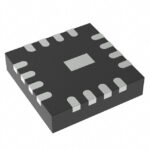 L6983N33QTR
Learn how rectifiers convert AC to DC, compare half-wave and bridge circuits, and select voltage, current, recovery and thermal ratings for your design.
Read More
Select a bridge rectifier by reverse voltage, capacitor charging current, startup surge and cooling. Work through a stated DC voltage and ripple example.
Read More
L6983N33QTR is listed in the Voltage Regulators - DC DC Switching Regulators range at ChipApex. The manufacturer field lists STMicroelectronics. Its product description is…
Read More
Learn how a pressure transducer converts pressure into voltage, current, or digital output, and compare pressure references and key selection specs.
Read More
L6983N33QTR is listed in the Voltage Regulators - DC DC Switching Regulators range at ChipApex. The manufacturer field lists STMicroelectronics. Its product description is…
Read More
L6983N33QTR is listed in the Voltage Regulators - DC DC Switching Regulators range at ChipApex. The manufacturer field lists STMicroelectronics. Its product description is…
Read More
L6983N33QTR is listed in the Voltage Regulators - DC DC Switching Regulators range at ChipApex. The manufacturer field lists STMicroelectronics. Its product description is…
Read More
L6983N33QTR is listed in the Voltage Regulators - DC DC Switching Regulators range at ChipApex. The manufacturer field lists STMicroelectronics. Its product description is…
Read More
L6983N33QTR is listed in the Voltage Regulators - DC DC Switching Regulators range at ChipApex. The manufacturer field lists STMicroelectronics. Its product description is…
Read More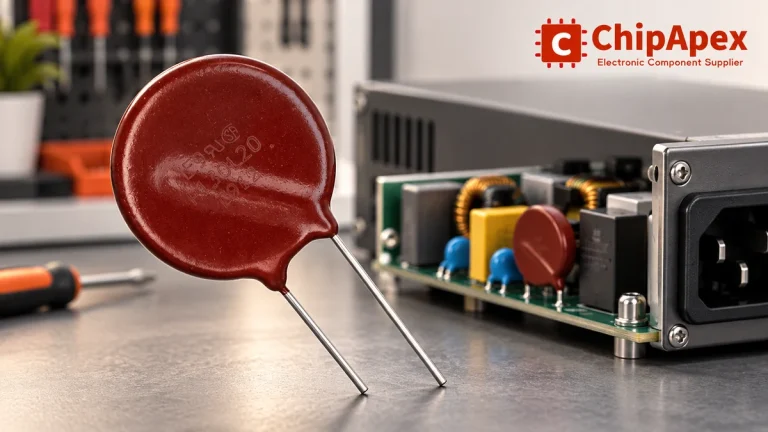
Select MOV varistors by continuous voltage, clamping behavior, surge waveform and repetition. Check thermal disconnection, fuse coordination and replacements.
Read More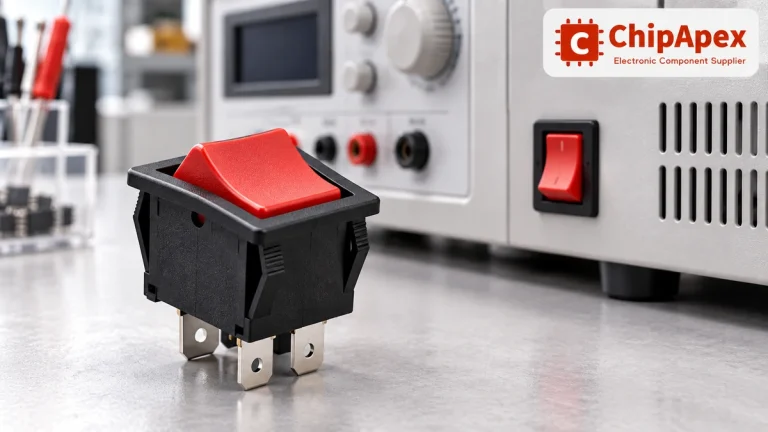
Choose a rocker switch by AC/DC ratings, contact arrangement, illumination, panel fit and sealing. Get practical checks for engineering and component sourcing.
Read More
See when an inductor behaves linearly, how DC bias and saturation reduce inductance, and which current and temperature curves to check.
Read More
The activity of extra discounts on wholesale prices is in full swing…
Please fill in your contact information and we will send you the latest wholesale price list.






