 ChipApex | Global Electronic Components Supplier

SEARCH
Search Product
Search Post
— IC芯片 | 连接器 | 传感器 | 被动器件 —
Search productSearch post
— IC芯片 | 连接器 | 传感器 | 被动器件 —
Consult the customer manager about the wholesale price.
consultation hotline:86-132-6715-2157
email:[email protected]
Contact the product manager for consultation. One-stop consultation is available.
Do you want a lower wholesale price? Please send us your inquiry and we will reply immediately.
LM5009MMX/NOPB is listed in the Voltage Regulators - DC DC Switching Regulators range at ChipApex. The manufacturer field lists Texas Instruments. Its product description is IC REG BUCK ADJ 150MA 8VSSOP. Review the specifications below when checking this part for your BOM.
The LM5009MMX/NOPB is a non-synchronous buck switching regulator manufactured by Texas Instruments. It features a wide input voltage range of 9.5V to 95V and delivers an output current of 150mA. The device utilizes a constant on-time (COT) control architecture with a fixed switching frequency of 600kHz. It provides an adjustable output voltage from 2.5V to 85V in a single-channel configuration. The component operates within a temperature range of -40°C to +125°C and is housed in an 8-pin VSSOP package.
Verify the specific suffix against official Texas Instruments documentation to confirm pinout and electrical characteristics, as variations may exist between tape-and-reel and cut-tape formats. Confirm RoHS compliance status through the manufacturer's product data sheet. Check for obsolescence notices or last-time-buy notifications prior to finalizing procurement plans to ensure long-term supply availability.
Select this component when designing circuits requiring a simple, cost-effective step-down solution for inputs exceeding standard low-voltage regulators. The fixed 600kHz frequency allows for smaller passive components compared to lower-frequency alternatives. Ensure the application load does not exceed the 150mA continuous output limit. Consider thermal management requirements given the small VSSOP-8 package footprint and lack of synchronous rectification.
This part belongs to the LM5009 family of high-voltage buck converters designed for robust performance in demanding environments. It serves as a non-synchronous alternative to synchronous variants like the LM5017, offering simpler drive requirements at the cost of slightly lower efficiency. The MMX variant specifically denotes the tape-and-reel packaging format suitable for automated surface-mount assembly processes.
Public confirmed substitute part numbers are not available in the provided source material.
Explore related parts through Power Management (PMIC), Integrated Circuits (ICs), all product categories, ChipApex homepage.
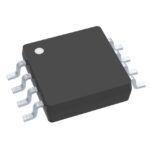 LM5009MMX/NOPB

Select a bridge rectifier by reverse voltage, capacitor charging current, startup surge and cooling. Work through a stated DC voltage and ripple example.
Read More
Learn how rectifiers convert AC to DC, compare half-wave and bridge circuits, and select voltage, current, recovery and thermal ratings for your design.
Read More
LM5009MMX/NOPB is listed in the Voltage Regulators - DC DC Switching Regulators range at ChipApex. The manufacturer field lists Texas Instruments. Its product description…
Read More
Choose a DIP switch by contact type, coded positions, footprint and signal ratings. Check logic polarity, assembly conditions and PCB configuration behavior.
Read More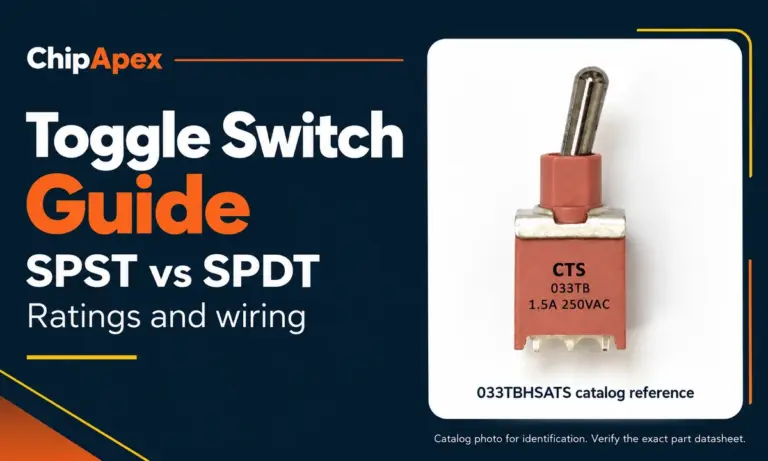
Compare SPST and SPDT toggle switches, understand AC/DC ratings, and follow wiring examples. Check contact action, mounting and parts in the ChipApex catalog.
Read More
Choose logic inverter ICs by thresholds, supply, output drive and delay. Compare standard and Schmitt-trigger inputs, power sequencing and replacement checks.
Read More
Learn what an IMU measures, how accelerometers and gyroscopes work together, why orientation estimates drift, and what to compare.
Read More
Understand tactile switches, PCB and keyboard differences, four-pin wiring, debounce, force, travel and replacement checks for reliable control inputs.
Read More
LM5009MMX/NOPB is listed in the Voltage Regulators - DC DC Switching Regulators range at ChipApex. The manufacturer field lists Texas Instruments. Its product description…
Read More
Learn why PTC resistance rises with temperature, how it differs from NTC, and which ratings matter for sensing and protection.
Read More
Compare Pt100 and Pt1000 RTDs, two-, three- and four-wire connections, excitation and self-heating. Build an error budget from element to reported temperature.
Read More
Find out when a bare shock switch needs a pull resistor, when an MCU internal pull-up is enough, and why sensor modules and piezo…
Read More
The activity of extra discounts on wholesale prices is in full swing…
Please fill in your contact information and we will send you the latest wholesale price list.







