 ChipApex | Global Electronic Components Supplier

SEARCH
Search Product
Search Post
— IC芯片 | 连接器 | 传感器 | 被动器件 —
Search productSearch post
— IC芯片 | 连接器 | 传感器 | 被动器件 —
Consult the customer manager about the wholesale price.
consultation hotline:86-132-6715-2157
email:[email protected]
Contact the product manager for consultation. One-stop consultation is available.
Do you want a lower wholesale price? Please send us your inquiry and we will reply immediately.
MCT2201 is listed in the Transistor, Photovoltaic Output Optoisolators range at ChipApex. The manufacturer field lists Isocom Components 2004 LTD. Its product description is OPTOISO 5.3KV TRANS W/BASE 6-DIP. Review the specifications below when checking this part for your BOM.
The MCT2201 is a single-channel optically coupled isolator manufactured by Isocom Components 2004 LTD. It integrates an infrared light-emitting diode with an NPN silicon phototransistor featuring a base terminal for enhanced switching control. The device provides a high isolation voltage of 5300Vrms and supports a maximum output voltage of 30V. It operates within a temperature range of -55°C to 100°C and is housed in a standard 6-DIP package with a 0.300-inch (7.62mm) lead spacing.
Verify the specific datasheet version from Isocom Components 2004 LTD, as specifications may vary between manufacturing batches. Confirm package dimensions and pinout compatibility with existing PCB footprints before integration. Ensure compliance with relevant environmental regulations applicable to your region.
Select this component when a low-cost, general-purpose isolator with a base terminal is required for basic digital signal transmission. The 6-DIP package facilitates through-hole mounting, making it suitable for prototyping or legacy board designs requiring robust electrical isolation.
The MCT2201 belongs to the MCT220_ series of optocouplers produced by Isocom Components 2004 LTD. This series is characterized by the use of infrared LEDs and NPN phototransistors in standard 6-pin dual in-line packages, offering a reliable solution for basic isolation tasks in various electronic circuits.
Direct substitutes include other single-channel transistor-output optocouplers in 6-DIP packages with similar isolation ratings, such as the CNY17 series or 4N25 variants, provided pinouts and current transfer ratios are compatible.
The base terminal allows for external connection to improve switching speed and linearity, providing better control over the transistor's operation compared to devices without a base pin.
The MCT2201 is rated for an isolation voltage of 5300Vrms, ensuring safe separation between input and output circuits under high-voltage conditions.
Explore related parts through Optocouplers, Optoisolators, Isolators, all product categories, ChipApex homepage.
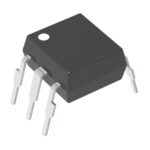 MCT2201

Learn why PTC resistance rises with temperature, how it differs from NTC, and which ratings matter for sensing and protection.
Read More
MCT2201 is listed in the Transistor, Photovoltaic Output Optoisolators range at ChipApex. The manufacturer field lists Isocom Components 2004 LTD. Its product description is…
Read More
Choose an AC to DC converter by input range, output demand, isolation, efficiency and thermal derating. Compare architectures and check installation needs.
Read More
MCT2201 is listed in the Transistor, Photovoltaic Output Optoisolators range at ChipApex. The manufacturer field lists Isocom Components 2004 LTD. Its product description is…
Read More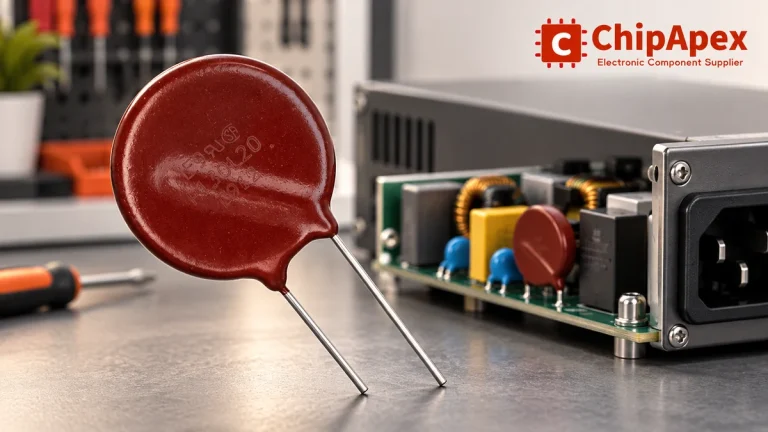
Select MOV varistors by continuous voltage, clamping behavior, surge waveform and repetition. Check thermal disconnection, fuse coordination and replacements.
Read More
Compare thermistors, RTDs, thermocouples and temperature ICs. Learn how range, accuracy, response, interfaces and mounting affect component selection.
Read More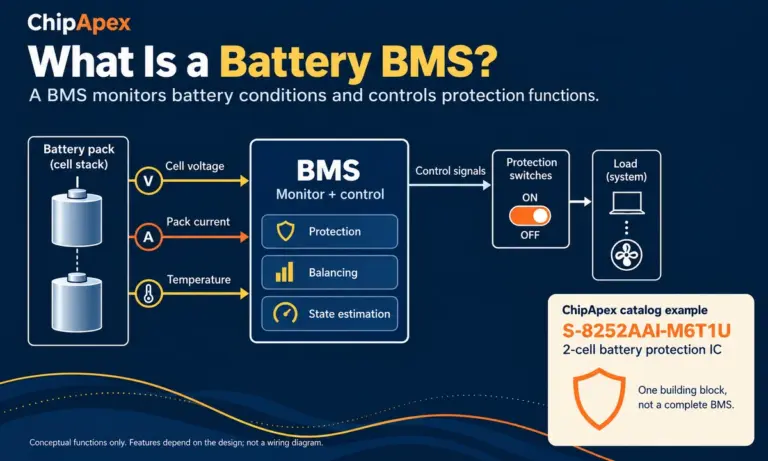
Learn what a battery BMS does, how protection differs from charging, and which pack specifications to check when sourcing BMS components through ChipApex.
Read More
Choose tactile switches by operating force, travel, actuator height, footprint and lifetime. Check debounce, sealing and the assembled button mechanism.
Read More
MCT2201 is listed in the Transistor, Photovoltaic Output Optoisolators range at ChipApex. The manufacturer field lists Isocom Components 2004 LTD. Its product description is…
Read More
MCT2201 is listed in the Transistor, Photovoltaic Output Optoisolators range at ChipApex. The manufacturer field lists Isocom Components 2004 LTD. Its product description is…
Read More
Learn how rectifiers convert AC to DC, compare half-wave and bridge circuits, and select voltage, current, recovery and thermal ratings for your design.
Read More
Understand how oscillators generate timing signals, how they differ from crystals, and which frequency, output and stability specs matter when choosing one.
Read More
The activity of extra discounts on wholesale prices is in full swing…
Please fill in your contact information and we will send you the latest wholesale price list.





