 ChipApex | Global Electronic Components Supplier

SEARCH
Search Product
Search Post
— IC芯片 | 连接器 | 传感器 | 被动器件 —
Search productSearch post
— IC芯片 | 连接器 | 传感器 | 被动器件 —
Consult the customer manager about the wholesale price.
consultation hotline:86-132-6715-2157
email:[email protected]
Contact the product manager for consultation. One-stop consultation is available.
Do you want a lower wholesale price? Please send us your inquiry and we will reply immediately.
SN74BCT29863BDW is listed in the Buffers, Drivers, Receivers, Transceivers range at ChipApex. The manufacturer field lists Texas Instruments. Its product description is IC TXRX NON-INVERT 5.5V 24SOIC. Review the specifications below when checking this part for your BOM.
The SN74BCT29863BDW is a 9-bit bus transceiver from Texas Instruments, designed for asynchronous communication between data buses. It operates within a supply voltage range of 4.5 V to 5.5 V and features non-inverting logic. The device utilizes a 24-pin SOIC package and supports surface mount installation. It provides three-state outputs with high drive capabilities, including a low-level output current of 48 mA and a high-level output current of -24 mA. The component functions reliably across an operating temperature range of 0°C to +70°C.
Verify the specific ordering suffix BDW confirms the 24-SOIC package and industrial temperature grade. Ensure compatibility with 4.5V to 5.5V logic levels in the target design. Confirm RoHS compliance status through official manufacturer documentation prior to integration.
Select this component when a 9-bit non-inverting transceiver is required for asynchronous bus applications. Consider the 24-SOIC package constraints and the 0°C to +70°C operating temperature range. Evaluate the drive strength requirements against the specified 48 mA low-level and -24 mA high-level output currents.
This part belongs to the SN74BCT series, which combines BiCMOS technology for high speed with CMOS low power consumption. The BCT family is optimized for high-density applications requiring fast switching speeds and reduced power dissipation compared to standard TTL or older CMOS logic families.
Check for pin-compatible alternatives within the same BCT family that offer similar bit widths and package types. Verify electrical characteristics match the original design requirements before substitution.
Explore related parts through Logic, Integrated Circuits (ICs), all product categories, ChipApex homepage.
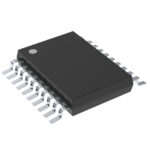 SN74BCT29863BDW
SN74BCT29863BDW is listed in the Buffers, Drivers, Receivers, Transceivers range at ChipApex. The manufacturer field lists Texas Instruments. Its product description is IC TXRX…
Read More
Learn how to use ferrite beads for noise filtering. Check impedance, DC bias, placement, resonance and load-step behavior before selecting a part.
Read More
SN74BCT29863BDW is listed in the Buffers, Drivers, Receivers, Transceivers range at ChipApex. The manufacturer field lists Texas Instruments. Its product description is IC TXRX…
Read More
Understand UART protocol framing, baud rate and electrical interfaces. Learn 8N1 timing, TX/RX wiring, buffering and practical troubleshooting steps.
Read More
SN74BCT29863BDW is listed in the Buffers, Drivers, Receivers, Transceivers range at ChipApex. The manufacturer field lists Texas Instruments. Its product description is IC TXRX…
Read MoreSN74BCT29863BDW is listed in the Buffers, Drivers, Receivers, Transceivers range at ChipApex. The manufacturer field lists Texas Instruments. Its product description is IC TXRX…
Read More
SN74BCT29863BDW is listed in the Buffers, Drivers, Receivers, Transceivers range at ChipApex. The manufacturer field lists Texas Instruments. Its product description is IC TXRX…
Read More
Learn how a diode conducts, how to identify anode and cathode, and when to choose rectifier, TVS, Zener or photodiode types for a circuit.
Read More
SN74BCT29863BDW is listed in the Buffers, Drivers, Receivers, Transceivers range at ChipApex. The manufacturer field lists Texas Instruments. Its product description is IC TXRX…
Read More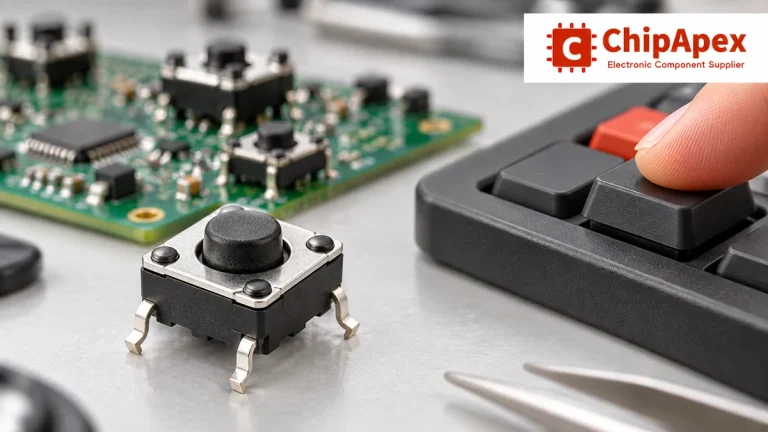
Understand tactile switches, PCB and keyboard differences, four-pin wiring, debounce, force, travel and replacement checks for reliable control inputs.
Read More
SN74BCT29863BDW is listed in the Buffers, Drivers, Receivers, Transceivers range at ChipApex. The manufacturer field lists Texas Instruments. Its product description is IC TXRX…
Read More
Learn how a TRIAC switches AC loads. Understand triggering, latching, holding current, phase control and thermal limits before choosing a component.
Read More
The activity of extra discounts on wholesale prices is in full swing…
Please fill in your contact information and we will send you the latest wholesale price list.





