 ChipApex | Global Electronic Components Supplier

SEARCH
Search Product
Search Post
— IC芯片 | 连接器 | 传感器 | 被动器件 —
Search productSearch post
— IC芯片 | 连接器 | 传感器 | 被动器件 —
Consult the customer manager about the wholesale price.
consultation hotline:86-132-6715-2157
email:[email protected]
Contact the product manager for consultation. One-stop consultation is available.
Do you want a lower wholesale price? Please send us your inquiry and we will reply immediately.
SN74LVC125ADRG3 is listed in the Buffers, Drivers, Receivers, Transceivers range at ChipApex. The manufacturer field lists Texas Instruments. Its product description is IC BUF NON-INVERT 3.6V 14SOIC. Review the specifications below when checking this part for your BOM.
The SN74LVC125ADRG3 is a quadruple bus buffer gate with 3-state outputs manufactured by Texas Instruments. It operates from a supply voltage of 1.65V to 3.6V and features independent output-enable inputs for each buffer. The device accepts input voltages up to 5.5V, allowing compatibility with 3.3V or 5V driving devices. It is housed in a 14-pin SOIC package and supports an operating temperature range from -40°C to 125°C.
Verify the specific ordering suffix 'DRG3' corresponds to the SOIC-14 package and tape-and-reel carrier configuration. Confirm the component meets RoHS standards and Level-1 moisture sensitivity ratings as specified in the manufacturer's packaging data sheet before finalizing procurement specifications.
Select this component for applications requiring low-voltage operation between 1.65V and 3.6V. The 5.5V tolerant inputs facilitate integration into mixed-voltage environments without external level shifting. Ensure the design accommodates the specified thermal resistance values for the SOIC-14 package under expected ambient conditions.
This part belongs to the SN74LVC125A family of quadruple bus buffer gates. The 'DRG3' suffix indicates a specific manufacturing variant packaged in a 14-pin Small Outline Integrated Circuit (SOIC) format. It is designed for high-speed digital signal buffering in portable and telecommunications equipment.
SN74LVC125ADRG4
To ensure the high-impedance state during power up or power down, the output-enable (OE) input should be tied to VCC through a pull-up resistor.
The inputs can accept voltages up to 5.5V, allowing them to be driven by either 3.3V or 5V devices regardless of the VCC supply voltage.
Explore related parts through Logic, Integrated Circuits (ICs), all product categories, ChipApex homepage.
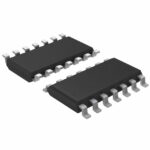 SN74LVC125ADRG3
SN74LVC125ADRG3 is listed in the Buffers, Drivers, Receivers, Transceivers range at ChipApex. The manufacturer field lists Texas Instruments. Its product description is IC BUF…
Read More
See how a MEMS gyroscope measures angular rate, why its angle estimate drifts, and which range, noise, interface and temperature specs to compare.
Read More
Choose logic inverter ICs by thresholds, supply, output drive and delay. Compare standard and Schmitt-trigger inputs, power sequencing and replacement checks.
Read More
Understand automotive relay terminals, coil suppression and load ratings. Check inrush, socket compatibility and temperature before selecting a replacement.
Read More
Compare RC, crystal and MEMS oscillator circuits. Check ppm, jitter, load capacitance, startup margin and output compatibility before choosing a clock source.
Read More
SN74LVC125ADRG3 is listed in the Buffers, Drivers, Receivers, Transceivers range at ChipApex. The manufacturer field lists Texas Instruments. Its product description is IC BUF…
Read More
Learn how rectifiers convert AC to DC, compare half-wave and bridge circuits, and select voltage, current, recovery and thermal ratings for your design.
Read More
SN74LVC125ADRG3 is listed in the Buffers, Drivers, Receivers, Transceivers range at ChipApex. The manufacturer field lists Texas Instruments. Its product description is IC BUF…
Read More
Understand tactile switches, PCB and keyboard differences, four-pin wiring, debounce, force, travel and replacement checks for reliable control inputs.
Read More
Learn how a JFET works and how to compare bias, leakage, noise and pinout. Review practical selection questions for high-impedance analog circuits.
Read More
SN74LVC125ADRG3 is listed in the Buffers, Drivers, Receivers, Transceivers range at ChipApex. The manufacturer field lists Texas Instruments. Its product description is IC BUF…
Read More
Understand load cell sensor output, bridge wiring and calibration. Learn how mV/V sensitivity, mechanics and ADC noise affect measurement accuracy.
Read More
The activity of extra discounts on wholesale prices is in full swing…
Please fill in your contact information and we will send you the latest wholesale price list.





