 ChipApex | Global Electronic Components Supplier

SEARCH
Search Product
Search Post
— IC芯片 | 连接器 | 传感器 | 被动器件 —
Search productSearch post
— IC芯片 | 连接器 | 传感器 | 被动器件 —
Consult the customer manager about the wholesale price.
consultation hotline:86-132-6715-2157
email:[email protected]
Contact the product manager for consultation. One-stop consultation is available.
Do you want a lower wholesale price? Please send us your inquiry and we will reply immediately.
SN74LVC540ADWR is listed in the Buffers, Drivers, Receivers, Transceivers range at ChipApex. The manufacturer field lists Texas Instruments. Its product description is IC BUFFER INVERT 3.6V 20SOIC. Review the specifications below when checking this part for your BOM.
The SN74LVC540ADWR is an octal buffer and line driver featuring three-state outputs, manufactured by Texas Instruments. It operates within a supply voltage range of 1.65V to 3.6V. The device provides high-level output current of -24mA and low-level output current of 24mA. It exhibits a maximum propagation delay (tpd) of 5.3ns at 3.3V. The component supports input voltages up to 5.5V, enabling compatibility with mixed 3.3V/5V systems. It is housed in a SOIC-20 package and functions reliably across an operating temperature range from -40°C to 85°C.
Verify the specific suffix 'DWR' corresponds to the tape-and-reel packaging format required for automated assembly processes. Confirm that the SOIC-20 package dimensions align with your printed circuit board footprint specifications. Ensure the operating temperature range meets the environmental requirements of the final application. Cross-reference the manufacturer part number with official Texas Instruments documentation to validate authenticity and revision status before procurement.
Select this component when an octal buffer with three-state control is required for low-voltage logic applications. The ability to tolerate 5.5V inputs makes it suitable for interfacing between 3.3V devices and legacy 5V systems. Consider the 5.3ns propagation delay for timing-sensitive designs. The SOIC-20 package offers a compact solution for space-constrained layouts while maintaining robust drive capabilities for bus structures.
This device belongs to the SNx4LVC540A family of octal buffers and drivers with three-state outputs. It is designed for high-speed digital applications requiring low power consumption and wide operating voltage ranges. The LVC series is characterized by its compatibility with various logic families and its ability to operate efficiently at lower supply voltages compared to older standard logic families.
Check for SN74LVC540ADW as a tube-packaged alternative if reel quantities are not required. Verify functional equivalence with other octal 3-state buffers in the LVC series from Texas Instruments or compatible manufacturers, ensuring pinout and electrical characteristics match.
Explore related parts through Logic, Integrated Circuits (ICs), all product categories, ChipApex homepage.
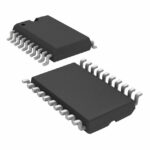 SN74LVC540ADWR

See how a MEMS gyroscope measures angular rate, why its angle estimate drifts, and which range, noise, interface and temperature specs to compare.
Read More
Compare thermistors, RTDs, thermocouples and temperature ICs. Learn how range, accuracy, response, interfaces and mounting affect component selection.
Read More
SN74LVC540ADWR is listed in the Buffers, Drivers, Receivers, Transceivers range at ChipApex. The manufacturer field lists Texas Instruments. Its product description is IC BUFFER…
Read More
Learn the relay definition, coil and contact operation, NO and NC forms, load ratings and suppression choices. Compare mechanical, reed and solid-state types.
Read More
SN74LVC540ADWR is listed in the Buffers, Drivers, Receivers, Transceivers range at ChipApex. The manufacturer field lists Texas Instruments. Its product description is IC BUFFER…
Read More
SN74LVC540ADWR is listed in the Buffers, Drivers, Receivers, Transceivers range at ChipApex. The manufacturer field lists Texas Instruments. Its product description is IC BUFFER…
Read More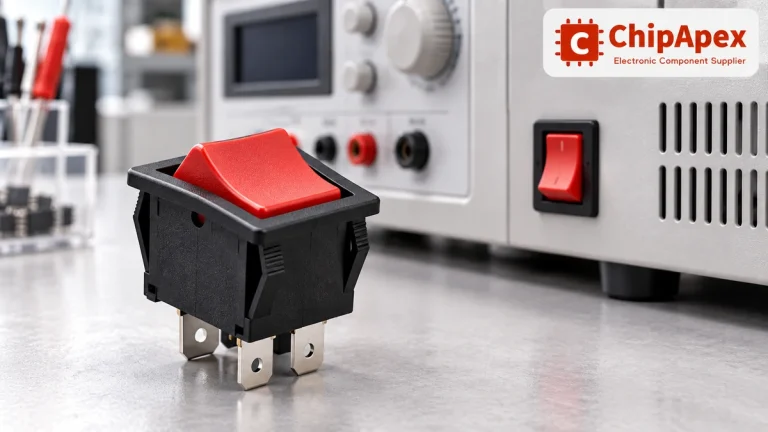
Choose a rocker switch by AC/DC ratings, contact arrangement, illumination, panel fit and sealing. Get practical checks for engineering and component sourcing.
Read More
SN74LVC540ADWR is listed in the Buffers, Drivers, Receivers, Transceivers range at ChipApex. The manufacturer field lists Texas Instruments. Its product description is IC BUFFER…
Read More
Choose a DIP switch by contact type, coded positions, footprint and signal ratings. Check logic polarity, assembly conditions and PCB configuration behavior.
Read More
Understand tactile switches, PCB and keyboard differences, four-pin wiring, debounce, force, travel and replacement checks for reliable control inputs.
Read More
Choose an AC to DC converter by input range, output demand, isolation, efficiency and thermal derating. Compare architectures and check installation needs.
Read More
Learn how a diode conducts, how to identify anode and cathode, and when to choose rectifier, TVS, Zener or photodiode types for a circuit.
Read More
The activity of extra discounts on wholesale prices is in full swing…
Please fill in your contact information and we will send you the latest wholesale price list.





