 ChipApex | Global Electronic Components Supplier

SEARCH
Search Product
Search Post
— IC芯片 | 连接器 | 传感器 | 被动器件 —
Search productSearch post
— IC芯片 | 连接器 | 传感器 | 被动器件 —
Consult the customer manager about the wholesale price.
consultation hotline:86-132-6715-2157
email:[email protected]
Contact the product manager for consultation. One-stop consultation is available.
Do you want a lower wholesale price? Please send us your inquiry and we will reply immediately.
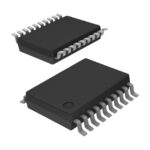
TLC0820ACDBR is listed in the Analog To Digital Converters (ADC) range at ChipApex. The manufacturer field lists Texas Instruments. Its product description is IC ADC 8BIT FLASH 20SSOP. Review the specifications below when checking this part for your BOM.
The TLC0820ACDBR is an 8-bit analog-to-digital converter manufactured by Texas Instruments, utilizing a modified flash architecture within the LinCMOS technology family. It features a single-ended input channel and provides parallel tri-state digital outputs compatible with both MOS and TTL logic levels. The device operates on a single 5 V supply, supporting a sampling rate of up to 400 kS/s with a maximum power dissipation of 37.5 mW. It is housed in a 20-pin SOIC package and functions across an industrial temperature range from -40°C to +85°C.
Verify the specific suffix 'DBR' corresponds to the tape and reel packaging format when ordering. Confirm that the operating environment remains within the specified -40°C to +85°C temperature limits. Ensure the external reference voltage requirements are met, as the device utilizes an external reference configuration rather than an internal one.
Select this component for applications requiring moderate resolution with high conversion speed. The modified flash structure offers faster performance compared to successive approximation register types while maintaining lower power consumption than traditional flash ADCs. Verify compatibility with the system's digital logic voltage levels before integration.
This part belongs to the TLC0820A series of advanced LinCMOS high-speed 8-bit analog-to-digital converters. The series is characterized by its use of modified flash techniques to achieve high throughput. The device serves as a bridge between analog sensor signals and digital processing units in embedded systems.
The TLC0820ACDR is a pin-compatible alternative offering similar electrical characteristics. Other variants in the series include the DIP-20 packaged TLC0820ACN.
Explore related parts through Data Acquisition, Integrated Circuits (ICs), all product categories, ChipApex homepage.
 TLC0820ACDBR

TLC0820ACDBR is listed in the Analog To Digital Converters (ADC) range at ChipApex. The manufacturer field lists Texas Instruments. Its product description is IC…
Read More
TLC0820ACDBR is listed in the Analog To Digital Converters (ADC) range at ChipApex. The manufacturer field lists Texas Instruments. Its product description is IC…
Read More
See when an inductor behaves linearly, how DC bias and saturation reduce inductance, and which current and temperature curves to check.
Read More
Learn why PTC resistance rises with temperature, how it differs from NTC, and which ratings matter for sensing and protection.
Read More
TLC0820ACDBR is listed in the Analog To Digital Converters (ADC) range at ChipApex. The manufacturer field lists Texas Instruments. Its product description is IC…
Read More
Learn how a diode conducts, how to identify anode and cathode, and when to choose rectifier, TVS, Zener or photodiode types for a circuit.
Read More
TLC0820ACDBR is listed in the Analog To Digital Converters (ADC) range at ChipApex. The manufacturer field lists Texas Instruments. Its product description is IC…
Read More
TLC0820ACDBR is listed in the Analog To Digital Converters (ADC) range at ChipApex. The manufacturer field lists Texas Instruments. Its product description is IC…
Read More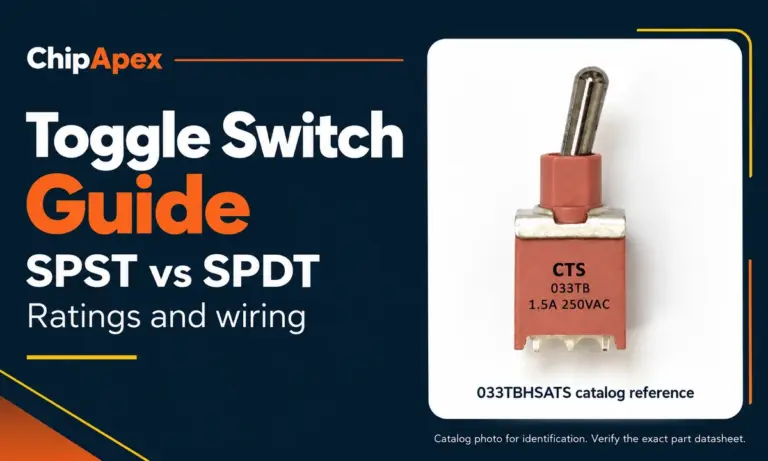
Compare SPST and SPDT toggle switches, understand AC/DC ratings, and follow wiring examples. Check contact action, mounting and parts in the ChipApex catalog.
Read More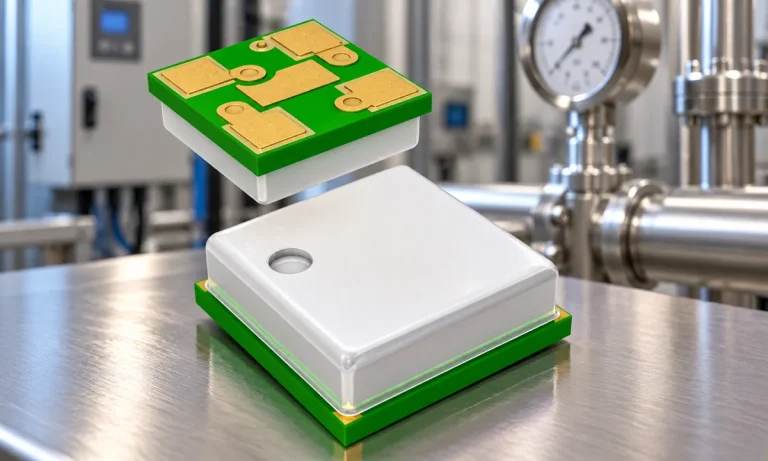
Learn how a pressure transducer converts pressure into voltage, current, or digital output, and compare pressure references and key selection specs.
Read More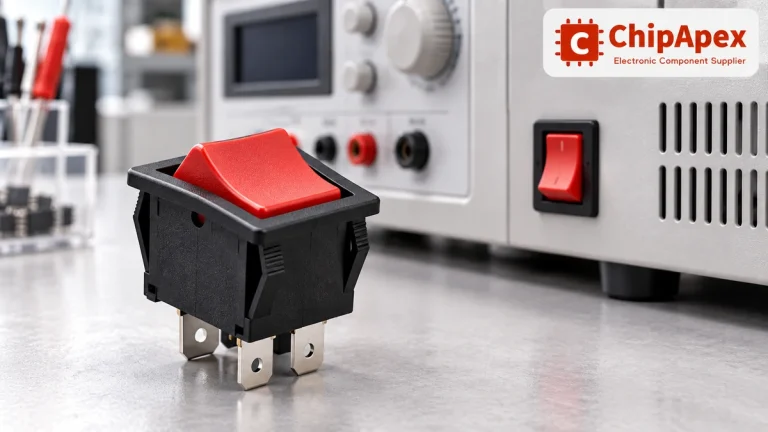
Choose a rocker switch by AC/DC ratings, contact arrangement, illumination, panel fit and sealing. Get practical checks for engineering and component sourcing.
Read More
Learn how rectifiers convert AC to DC, compare half-wave and bridge circuits, and select voltage, current, recovery and thermal ratings for your design.
Read More
The activity of extra discounts on wholesale prices is in full swing…
Please fill in your contact information and we will send you the latest wholesale price list.





