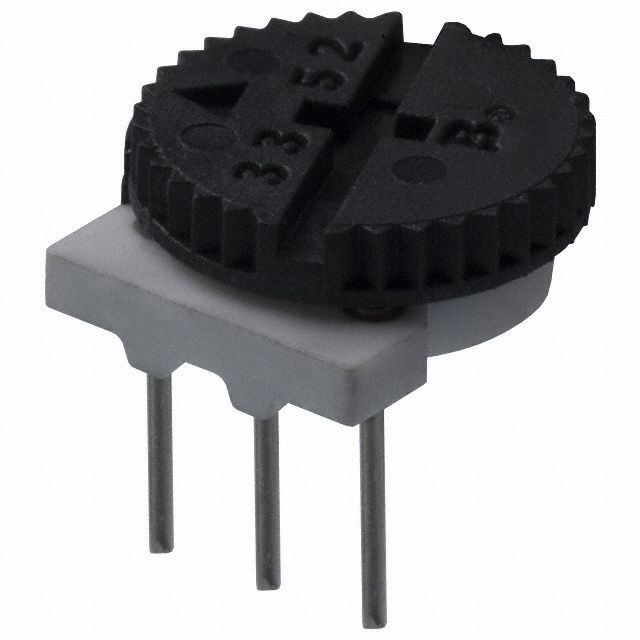
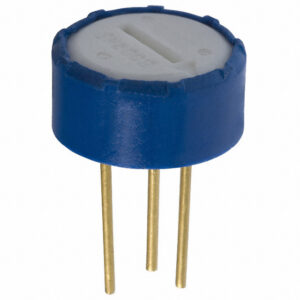
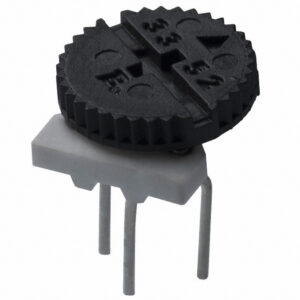
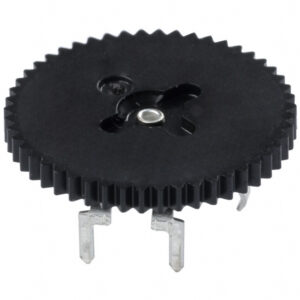
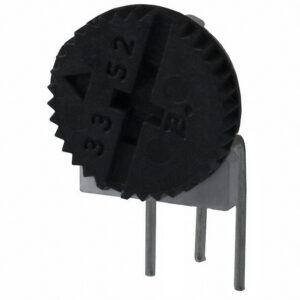
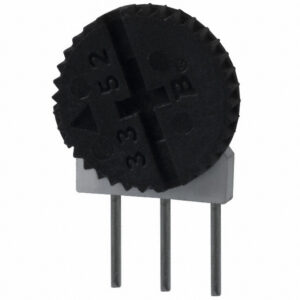
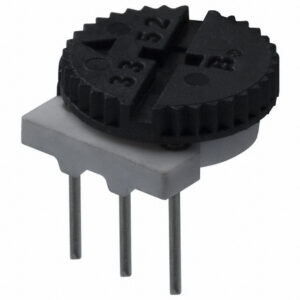
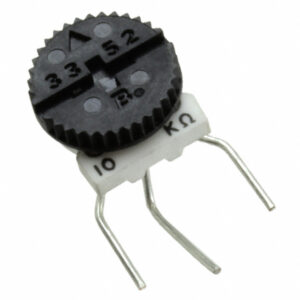
Thumbwheel potentiometers allow for manual adjustment of an in-circuit resistance value. Also known as thumbwheel trim pots, they are available in side or top adjustment and include a tactile edge on the actuator for human interaction and position indication. They range in value from 10Ω to 5MΩ of resistance and 5% to 30% of value tolerance in surface and through hole mounting configurations.
ScreenDefaultRankingPrice By Date
Thumbwheel Potentiometers: Features and Specifications
Function in the design. A thumbwheel potentiometer adjusts resistance through a compact rotating wheel. Start with the role the component plays in the adjustment circuit. Check resistance range, taper, mounting direction and wheel access. A potentiometer uses a wiper on a resistive element to provide an adjustable ratio or resistance. On the assembly drawing, identify which part performs each function. That distinction is useful when two catalog categories have similar names.
3352T-1-104LF at a glance. The listing for 3352T-1-104LF gives resistance as 100 kOhms, power (watts) as 0.5W, 1/2W, tolerance as ±20%. These values apply to this ordering code. Check the manufacturer’s description before carrying them over to another member of the family. When you enter a rating in the bill of materials, copy its unit and the conditions attached to it. That gives the next engineer enough information to compare another part on the same basis.
Differences within the range. For resistance, 3352T-1-104LF is listed as 100 kOhms and 3352T-1-103LF as 10 kOhms. When comparing thumbwheel potentiometers, distinguish a property shown for an individual model from a requirement shared by the whole design. Short descriptions often omit the detail that decides whether a part fits. Check the drawing for differences that affect assembly. For differences in operation, find the corresponding row in the manufacturer’s characteristic table and read the test conditions.
Thumbwheel Potentiometers: Applications and Design Considerations
Typical operating conditions. It provides local manual adjustment where a projecting shaft would be inconvenient. For this use, specify resistance law, end resistance, adjustment range and access to the actuator. Write down the conditions at the installation site. If the bench setup reproduces only one of them, record what still needs testing in the assembled equipment. Include at least one representative operating case and the most demanding credible case in the comparison.
Integration example. The listing for 3352T-1-103LF gives power (watts) as 0.5W, 1/2W, tolerance as ±20%, number of turns as 1.0. Which of those values does the existing design fix? Mark those first. The remaining values give you room to consider another part. The listing for 91AR1KLF gives adjustment type as Top Adjustment, size / dimension as Round - 0.375" Dia x 0.200" H (9.53mm x 5.08mm), termination as PC Pins. For an existing interface, place its drawing next to the product record. Resolve any discrepancy while the layout can still change and before ordering parts for evaluation.
Checks on the prototype. Check both ends of travel and the intermediate settings. A suitable nominal resistance cannot compensate for an unsuitable taper or inaccessible adjustment point. Record how the part was installed and what you observed. Include the operating conditions so someone else can repeat the measurement. During the thumbwheel potentiometers check, check resistance range, taper, mounting direction and wheel access. If the reading is near the limit, repeat the original measurement. Then vary one condition at a time to see whether the component or the setup accounts for the difference.
Selection Criteria for Thumbwheel Potentiometers
Define the acceptance criteria. Check resistance range, taper, mounting direction and wheel access. Set a pass or fail limit for each critical requirement before comparing prices. For this category, useful starting columns from the catalog include resistance, power (watts), tolerance, number of turns. Give each critical value a unit and an acceptable range. A blank field leaves an open question. Check the datasheet for that particular ordering code before entering a value in the comparison table.
Compare exact ordering codes. The listing for 91AR1KLF gives tolerance as ±20%, number of turns as 1.0, adjustment type as Top Adjustment. Check the complete manufacturer part number, including suffixes, against the ordering table for the device you intend to buy. For size / dimension, the respective entries for 3352T-1-103LF and 91AR1KLF are Round - 0.350" Dia x 0.150" H (8.89mm x 3.81mm) and Round - 0.375" Dia x 0.200" H (9.53mm x 5.08mm). Check which of these values the assembly drawing or design specification requires. If the table gives only a typical value, look for a guaranteed limit at your operating conditions. The typical figure alone gives you little basis for rejecting a delivered part.
Prepare the purchase specification. For a quotation, identify the required thumbwheel potentiometers by manufacturer and complete part number. If alternatives are acceptable, state which differences require engineering approval. Tell purchasing how many pieces you need, when they must arrive and which packing formats the assembly line can accept. Before approving an alternative for the adjustment circuit, compare it against the same acceptance criteria used for the original part and keep the comparison with the released bill of materials.
 ChipApex | Global Electronic Components Supplier