 ChipApex | Global Electronic Components Supplier

SEARCH
Search Product
Search Post
— IC芯片 | 连接器 | 传感器 | 被动器件 —
Search productSearch post
— IC芯片 | 连接器 | 传感器 | 被动器件 —
Consult the customer manager about the wholesale price.
consultation hotline:86-132-6715-2157
email:[email protected]
Contact the product manager for consultation. One-stop consultation is available.
Do you want a lower wholesale price? Please send us your inquiry and we will reply immediately.
The SICK model 2108571 is a system plug designed for the nanoScan3 laser scanner series. It serves as an extension module to facilitate cable routing and signal distribution within industrial automation setups. The component supports standard communication interfaces compatible with the nanoScan3 platform, enabling seamless integration into safety and monitoring applications. It ensures reliable data transmission and power supply continuity in demanding operational environments.
Verify compatibility with specific nanoScan3 variants before procurement. Confirm interface requirements match existing system architecture. Ensure environmental ratings meet installation site conditions. Check for required firmware versions if applicable. Validate mechanical dimensions against enclosure constraints.
Select this part when extending cabling or distributing signals for nanoScan3 units. Consider environmental factors such as temperature and ingress protection. Evaluate communication protocol needs for the specific application. Ensure mechanical fit within the designated mounting space.
This component belongs to the nanoScan3 accessory line by SICK. It complements the primary laser scanner units by providing necessary connectivity infrastructure. The product is part of a broader ecosystem of sensors and accessories for industrial safety and tracking.
No direct public substitute part numbers are confirmed for this specific system plug variant. Verify functional equivalence with other nanoScan3 system plugs if original availability is limited.
 2108571
Choose an AC to DC converter by input range, output demand, isolation, efficiency and thermal derating. Compare architectures and check installation needs.
Read More
[Shenzhen/Shanghai/Beijing, January 2025] — As global digital transformation accelerates, the electronic components industry has reached a critical inflection point in 2025. Emerging fields such…
Read More
Learn how a JFET works and how to compare bias, leakage, noise and pinout. Review practical selection questions for high-impedance analog circuits.
Read More
Learn how rectifiers convert AC to DC, compare half-wave and bridge circuits, and select voltage, current, recovery and thermal ratings for your design.
Read More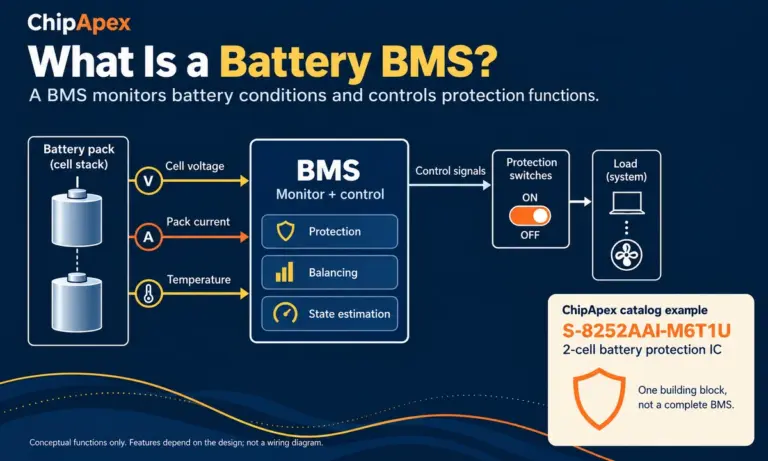
Learn what a battery BMS does, how protection differs from charging, and which pack specifications to check when sourcing BMS components through ChipApex.
Read More
In the embedded world, general-purpose CPUs are great at running operating systems, and MCUs excel at logic control. But when you need to process…
Read More
Choose a DIP switch by contact type, coded positions, footprint and signal ratings. Check logic polarity, assembly conditions and PCB configuration behavior.
Read More
Choose LED drivers by current, string voltage, dimming and thermal limits. Understand constant-current operation and the checks needed for your load.
Read More
Learn why PTC resistance rises with temperature, how it differs from NTC, and which ratings matter for sensing and protection.
Read More
In the world of electronics, memory components play a critical role in system performance—and DRAM (Dynamic Random-Access Memory) is one of the most widely…
Read More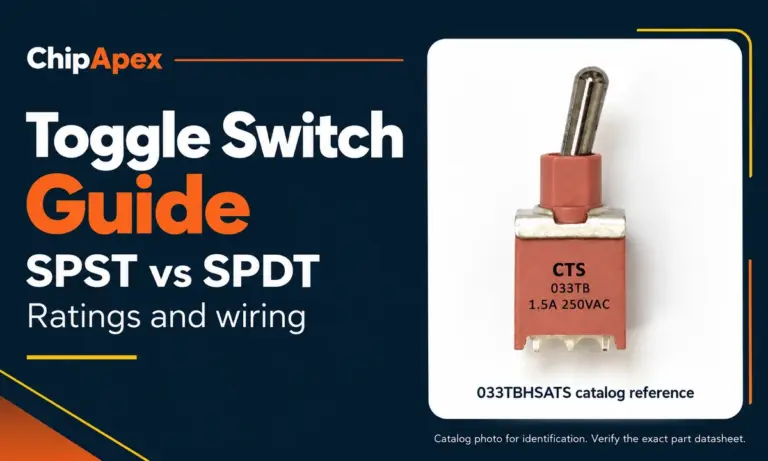
Compare SPST and SPDT toggle switches, understand AC/DC ratings, and follow wiring examples. Check contact action, mounting and parts in the ChipApex catalog.
Read More
Learn how a diode conducts, how to identify anode and cathode, and when to choose rectifier, TVS, Zener or photodiode types for a circuit.
Read More
The activity of extra discounts on wholesale prices is in full swing…
Please fill in your contact information and we will send you the latest wholesale price list.




