 ChipApex | Global Electronic Components Supplier

SEARCH
Search Product
Search Post
— IC芯片 | 连接器 | 传感器 | 被动器件 —
Search productSearch post
— IC芯片 | 连接器 | 传感器 | 被动器件 —
Consult the customer manager about the wholesale price.
consultation hotline:86-132-6715-2157
email:[email protected]
Contact the product manager for consultation. One-stop consultation is available.
Do you want a lower wholesale price? Please send us your inquiry and we will reply immediately.
IXD1415HH01ER-G is listed in the Voltage Regulators - Linear, Low Drop Out (LDO) Regulators range at ChipApex. The manufacturer field lists Zilog. Its product description is IC REG LINEAR 1.8V/2.8V 6-USPC. Review the specifications below when checking this part for your BOM.
The IXD1415HH01ER-G is a dual high-speed low dropout (LDO) voltage regulator manufactured by Zilog. It provides two independent output channels with a total current capacity of 200mA per channel. The device belongs to the PMIC category and is designed for applications requiring stable, low-noise power delivery. It is supplied in a Reel packaging format.
Verify component authenticity through authorized Zilog distributors or certified suppliers. Confirm the specific suffix HH01 matches design requirements. Check for restricted availability status as indicated by current inventory data. Ensure compliance with environmental and trade regulations relevant to the destination region before finalizing procurement orders.
Select this component when dual isolated outputs are required within a single package. Consider the 200mA rating against peak load demands. Evaluate thermal performance based on expected ambient conditions and PCB layout. Verify input voltage ranges align with system power sources to ensure proper LDO operation without entering dropout regions under varying load conditions.
This part is part of the IXD1415 series from Zilog, categorized under Low Dropout Regulators. It serves as a power management integrated circuit (PMIC). The series offers various output voltage configurations distinguished by alphanumeric suffixes, allowing designers to choose specific regulated levels without changing the core regulator topology.
Cross-reference with other IXD1415 variants such as IXD1415CC01ER-G or IXD1415GGB1ER-G if different output voltages are needed. Ensure pin compatibility and electrical specifications match before substituting. Verify that alternative parts maintain the same dual-channel high-speed LDO characteristics.
Explore related parts through Power Management (PMIC), Integrated Circuits (ICs), all product categories, ChipApex homepage.
 IXD1415HH01ER-G

Understand how a comparator switches at a voltage threshold, why hysteresis prevents chatter, and which output and input specs matter.
Read More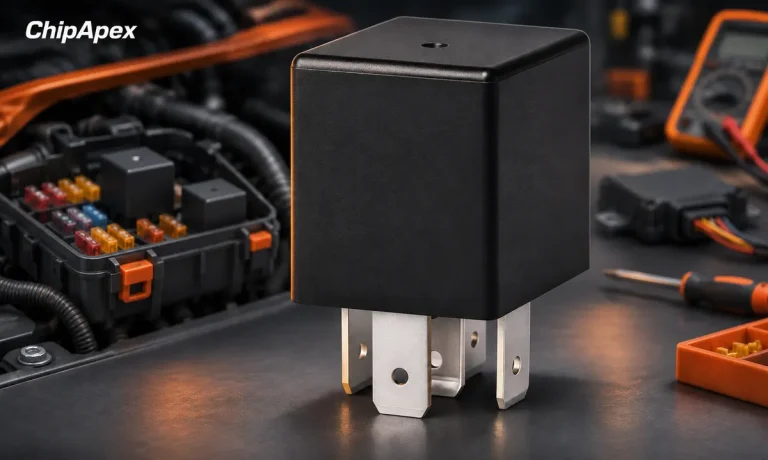
Understand automotive relay terminals, coil suppression and load ratings. Check inrush, socket compatibility and temperature before selecting a replacement.
Read More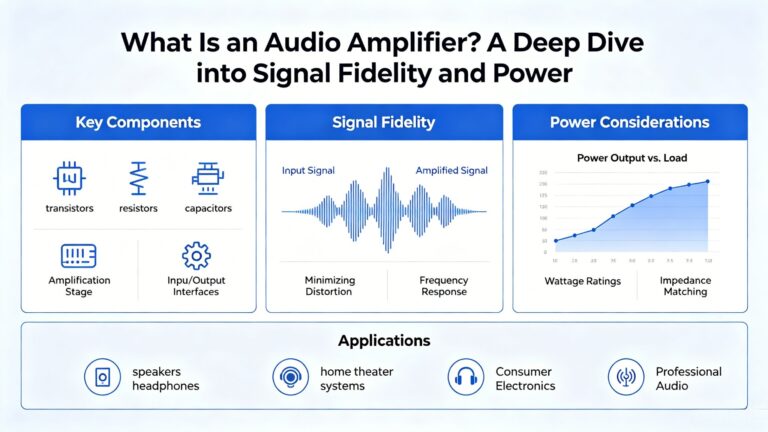
IXD1415HH01ER-G is listed in the Voltage Regulators - Linear, Low Drop Out (LDO) Regulators range at ChipApex. The manufacturer field lists Zilog. Its product…
Read More
See how a MEMS gyroscope measures angular rate, why its angle estimate drifts, and which range, noise, interface and temperature specs to compare.
Read More
Understand how oscillators generate timing signals, how they differ from crystals, and which frequency, output and stability specs matter when choosing one.
Read More
IXD1415HH01ER-G is listed in the Voltage Regulators - Linear, Low Drop Out (LDO) Regulators range at ChipApex. The manufacturer field lists Zilog. Its product…
Read More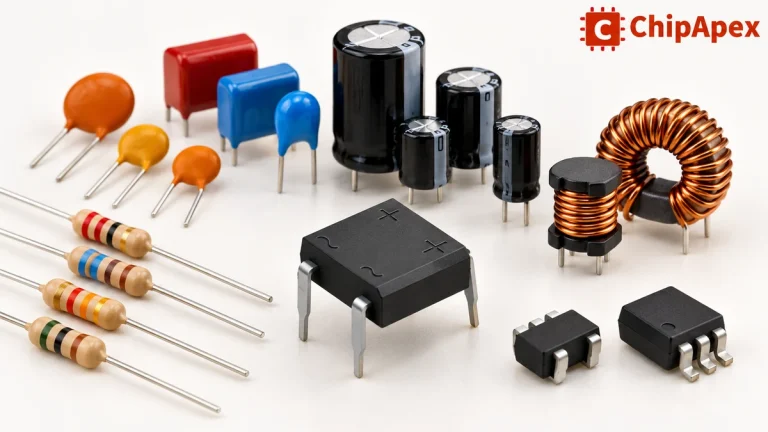
Explore electronic component types, functions, packages and datasheets. Learn selection, replacement and BOM checks before ordering parts for your PCB.
Read More
Choose a DIP switch by contact type, coded positions, footprint and signal ratings. Check logic polarity, assembly conditions and PCB configuration behavior.
Read More
Understand tactile switches, PCB and keyboard differences, four-pin wiring, debounce, force, travel and replacement checks for reliable control inputs.
Read More
IXD1415HH01ER-G is listed in the Voltage Regulators - Linear, Low Drop Out (LDO) Regulators range at ChipApex. The manufacturer field lists Zilog. Its product…
Read More
IXD1415HH01ER-G is listed in the Voltage Regulators - Linear, Low Drop Out (LDO) Regulators range at ChipApex. The manufacturer field lists Zilog. Its product…
Read More
Choose a vibration sensor for machine monitoring. Compare sensing methods, bandwidth, noise and mounting, then define the signal-chain requirements.
Read More
The activity of extra discounts on wholesale prices is in full swing…
Please fill in your contact information and we will send you the latest wholesale price list.




