 ChipApex | Global Electronic Components Supplier

SEARCH
Search Product
Search Post
— IC芯片 | 连接器 | 传感器 | 被动器件 —
Search productSearch post
— IC芯片 | 连接器 | 传感器 | 被动器件 —
Consult the customer manager about the wholesale price.
consultation hotline:86-132-6715-2157
email:[email protected]
Contact the product manager for consultation. One-stop consultation is available.
Do you want a lower wholesale price? Please send us your inquiry and we will reply immediately.
VS-32CTQ030-N3 is listed in the Diode Arrays range at ChipApex. The manufacturer field lists Vishay General Semiconductor - Diodes Division. Its product description is DIODE ARR SCHOTT 30V 30A TO2203. Review the specifications below when checking this part for your BOM.
The Vishay VS-32CTQ030-N3 is a Schottky rectifier featuring a dual anode common cathode configuration housed in a TO-220AB package. It provides a maximum average forward current of 30 A and a maximum repetitive peak reverse voltage of 30 V. The device supports junction temperatures up to 150 °C with a typical forward voltage drop of 0.40 V at 15 Apk and 125 °C. Maximum non-repetitive surge current reaches 900 A for a 5 μs sine pulse, while the maximum reverse leakage current is 97 mA at 125 °C.
Verify the specific ordering suffix against official documentation to confirm compliance status. The -N3 designation indicates halogen-free, RoHS compliant, and totally lead-free construction. Confirm that the required quantity aligns with the standard packaging minimum order quantity of 1000 units per antistatic plastic tube before finalizing procurement.
Select this component when applications require reliable operation at junction temperatures up to 150 °C. The low forward voltage drop minimizes conduction losses in high-frequency switching environments. Ensure thermal management design accommodates the specified thermal resistance from junction to case for optimal performance under continuous load conditions.
This part belongs to the VS-32CTQ... Schottky rectifier series designed for optimized low reverse leakage at high temperatures. The series utilizes proprietary barrier technology to support reliable operation up to 150 °C junction temperature. It is manufactured by Vishay Semiconductors and intended for general-purpose high-power rectification tasks.
The datasheet lists VS-32CTQ030PbF as a related variant within the same product family. Verify if the PbF version meets specific halogen-free requirements, as the -N3 suffix explicitly denotes halogen-free construction. Cross-reference electrical ratings and package dimensions to ensure compatibility.
The maximum junction temperature (TJ) range extends up to 150 °C.
The device features a dual anode common cathode configuration with two independent Schottky elements.
The device can withstand a maximum peak one-cycle non-repetitive surge current of 900 A for a 5 μs sine pulse.
Explore related parts through Rectifiers, Diodes, Discrete Semiconductor Products, all product categories.
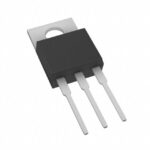 VS-32CTQ030-N3
VS-32CTQ030-N3 is listed in the Diode Arrays range at ChipApex. The manufacturer field lists Vishay General Semiconductor - Diodes Division. Its product description is…
Read More
VS-32CTQ030-N3 is listed in the Diode Arrays range at ChipApex. The manufacturer field lists Vishay General Semiconductor - Diodes Division. Its product description is…
Read More
Learn how rectifiers convert AC to DC, compare half-wave and bridge circuits, and select voltage, current, recovery and thermal ratings for your design.
Read More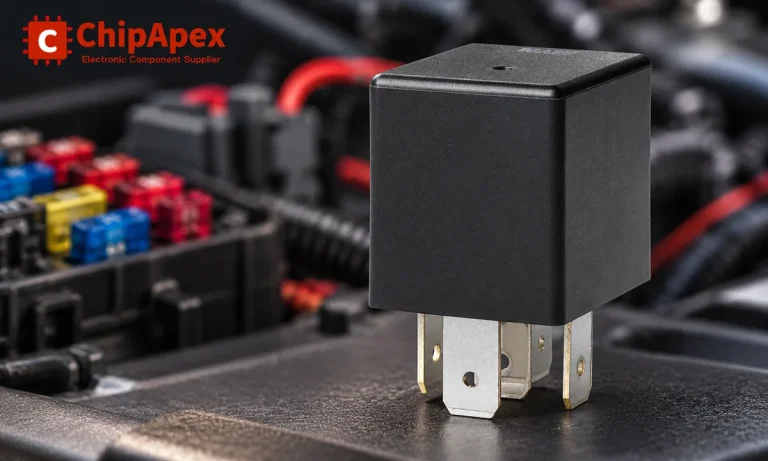
Learn the relay definition, coil and contact operation, NO and NC forms, load ratings and suppression choices. Compare mechanical, reed and solid-state types.
Read More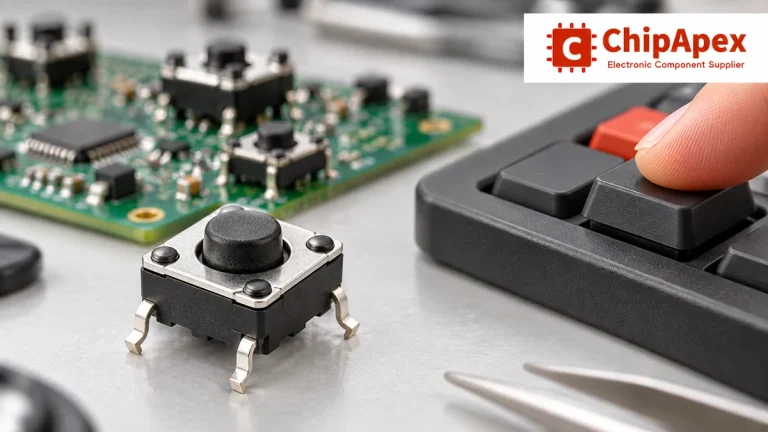
Understand tactile switches, PCB and keyboard differences, four-pin wiring, debounce, force, travel and replacement checks for reliable control inputs.
Read More
VS-32CTQ030-N3 is listed in the Diode Arrays range at ChipApex. The manufacturer field lists Vishay General Semiconductor - Diodes Division. Its product description is…
Read More
VS-32CTQ030-N3 is listed in the Diode Arrays range at ChipApex. The manufacturer field lists Vishay General Semiconductor - Diodes Division. Its product description is…
Read More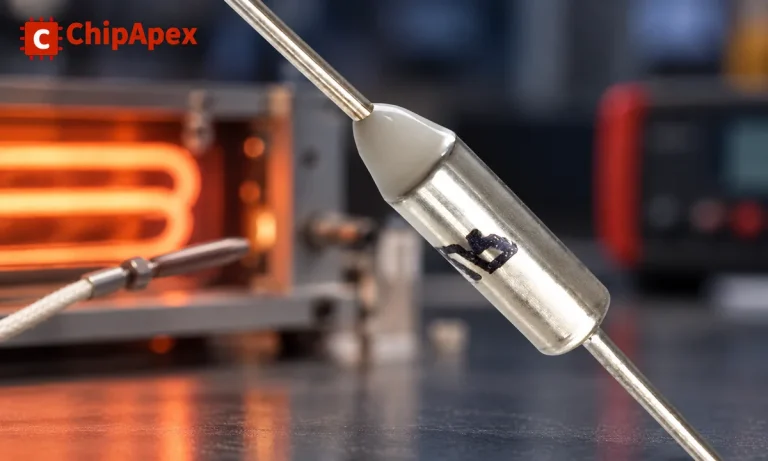
Understand thermal fuse operation, Tf, Th and Tm, electrical ratings and mounting. Check temperature limits and replacement requirements for your design.
Read More
VS-32CTQ030-N3 is listed in the Diode Arrays range at ChipApex. The manufacturer field lists Vishay General Semiconductor - Diodes Division. Its product description is…
Read More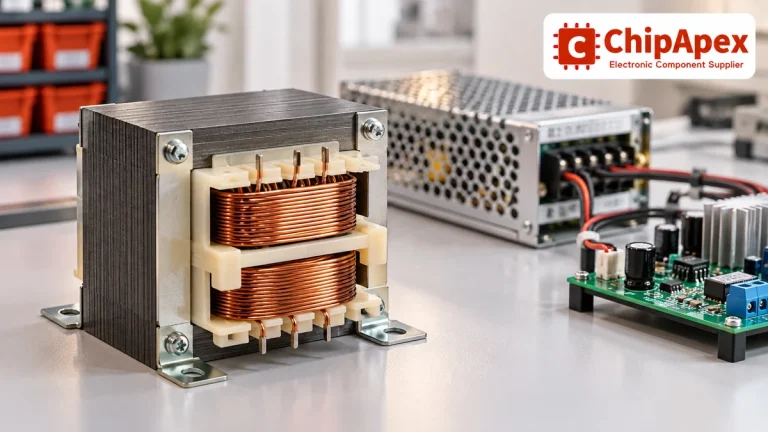
Select power transformers by input frequency, secondary VA, rectifier load, isolation, regulation and inrush. Build a clearer specification for your next RFQ.
Read More
Learn why PTC resistance rises with temperature, how it differs from NTC, and which ratings matter for sensing and protection.
Read More
Choose a DIP switch by contact type, coded positions, footprint and signal ratings. Check logic polarity, assembly conditions and PCB configuration behavior.
Read More
The activity of extra discounts on wholesale prices is in full swing…
Please fill in your contact information and we will send you the latest wholesale price list.




